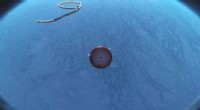
* Free Fall: This means an object is moving under the sole influence of gravity. Air resistance is initially ignored in this concept.
* Terminal Velocity: This is the constant speed that a freely falling object eventually reaches when the force of air resistance equals the force of gravity.
Here's how it works:
1. Initial Fall: When an object first starts falling, gravity pulls it downwards, causing it to accelerate.
2. Air Resistance Builds: As the object falls faster, air resistance (also called drag) increases. This force opposes the object's motion.
3. Reaching Equilibrium: Eventually, the force of air resistance becomes equal in magnitude to the force of gravity acting on the object. At this point, the net force on the object is zero.
4. Constant Velocity: Since there is no net force, the object stops accelerating and continues to fall at a constant speed – this is terminal velocity.
Important Factors:
* Shape and Surface Area: Objects with larger surface areas or less aerodynamic shapes experience greater air resistance and reach terminal velocity sooner.
* Mass: Heavier objects have a stronger gravitational force acting on them, but they also tend to have greater inertia, meaning they resist changes in motion. This can affect the time it takes to reach terminal velocity.
Let me know if you'd like to know more about any specific aspect of this!