1. Nuclear Energy:
* Nuclear Fission: The equation helps explain how energy is released during nuclear fission, the process that powers nuclear power plants. When heavy atoms like Uranium are split, a small amount of mass is converted into a massive amount of energy, as described by E=mc².
* Nuclear Fusion: This process, which powers stars, involves fusing lighter atoms like hydrogen into heavier ones, releasing even more energy than fission. Again, E=mc² explains the energy release.
2. Particle Physics:
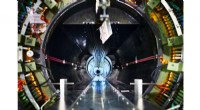
* Particle Accelerators: E=mc² helps explain the behavior of particles in accelerators like the Large Hadron Collider. The energy of accelerated particles can be converted into mass, creating new particles.
* Antimatter: The equation helps understand the relationship between mass and energy in antimatter, which has the opposite charge of ordinary matter.
3. Cosmology:
* Stellar Evolution: E=mc² is fundamental to understanding how stars evolve. Nuclear fusion within stars converts mass into energy, powering their light and heat.
* Black Holes: E=mc² plays a role in explaining the extreme gravity of black holes. Their immense density means a small amount of mass can have a huge gravitational pull, due to the vast amount of energy associated with that mass.
4. Other Applications:
* Dating Techniques: Radioactive decay, which is related to E=mc², is used in radiometric dating methods to determine the age of fossils and rocks.
* Medical Imaging: Positron Emission Tomography (PET) scans rely on the annihilation of matter and antimatter, a process explained by E=mc², to produce images of the inside of the human body.
It's important to note:
* E=mc² is a simplified equation that describes the relationship between mass and energy at rest. In reality, the full equation is more complex and accounts for momentum and other factors.
* While E=mc² has profound implications, it's not the only equation used in these fields. Scientists rely on a vast array of complex equations and models to understand the universe.
Overall, E=mc² has been a foundational tool for scientists across various fields, leading to breakthroughs in our understanding of the universe and enabling the development of revolutionary technologies.