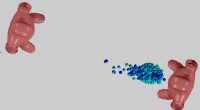
Understanding Longitudinal Waves
* Direction of Motion: In a longitudinal wave, the particles of the medium vibrate *parallel* to the direction the wave travels. Think of it like a slinky being pushed and pulled along its length.
* Compressions and Rarefactions: The vibrations create areas of higher density called compressions (where the particles are close together) and areas of lower density called rarefactions (where the particles are spread out).
How Particles Move
1. Starting Point: Imagine a line of particles (think of atoms or molecules) in the medium.
2. Disturbance: A force starts the wave by pushing or pulling a particle in the line. This particle moves back and forth in a small space.
3. Transfer of Energy: The disturbed particle bumps into its neighbor, transferring some of its energy. This neighbor then also starts vibrating back and forth.
4. Chain Reaction: This process continues down the line of particles, with each particle passing energy to its neighbor.
5. Compression and Rarefaction: As the particles move back and forth, they bunch together (compressions) when moving in the same direction and spread apart (rarefactions) when moving in opposite directions.
6. Wave Propagation: This pattern of compressions and rarefactions propagates through the medium as the wave travels.
Visualizing it
Think of a slinky:
* Compression: When you push on the slinky, the coils bunch together.
* Rarefaction: When you pull on the slinky, the coils spread out.
The slinky itself doesn't travel down the hallway (like a transverse wave), but the pattern of compression and rarefaction does.
Examples of Longitudinal Waves
* Sound waves: Sound travels through air, water, and solids as longitudinal waves. The compressions and rarefactions cause changes in air pressure that our ears detect.
* Seismic P-waves: These are the fastest type of earthquake waves. They travel through the Earth's interior as compressions and rarefactions.
Let me know if you'd like to know more about transverse waves or any other wave phenomena!