1. Electrons Instead of Light:
* Light Microscopes: Traditional microscopes use visible light to illuminate a sample. However, light waves are too large to resolve objects smaller than about 200 nanometers.
* Electron Microscopes: TEMs overcome this limitation by using a beam of electrons instead of light. Electrons have much shorter wavelengths than light, allowing them to interact with much smaller objects.
2. The Electron Beam:
* Generation: A filament in the TEM heats up to release electrons. These electrons are then accelerated using a high voltage.
* Focus: Electromagnetic lenses, similar to the lenses in a light microscope but using magnetic fields, focus the electron beam into a very thin, focused beam.
3. Interaction with the Sample:
* Thin Specimen: The sample must be extremely thin (often only a few nanometers thick) to allow the electron beam to pass through it.
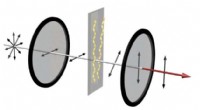
* Scattering: As the electrons pass through the sample, they interact with the atoms of the material. Some electrons pass straight through, while others are scattered in different directions. This scattering depends on the density and composition of the sample.
4. Image Formation:
* Projection: The scattered and unscattered electrons are projected onto a fluorescent screen or captured by a digital detector.
* Contrast: The areas where more electrons pass through (less scattering) appear brighter, while areas with more scattering appear darker. This difference in brightness creates the image.
5. Magnification:
* Electron Lenses: Electromagnetic lenses are used to magnify the image of the sample. TEMs can achieve magnifications up to millions of times, far exceeding the capabilities of light microscopes.
Key Points:
* Resolution: TEMs have a much higher resolution than light microscopes, allowing us to see objects as small as a few angstroms (0.1 nanometers).
* Sample Preparation: Preparing samples for TEM is crucial. This usually involves slicing the material very thin, embedding it in a resin, and staining it with heavy metals to enhance contrast.
* Applications: TEM is used in a wide range of scientific fields, including materials science, biology, medicine, and nanotechnology.
Let me know if you'd like more details on any of these points!