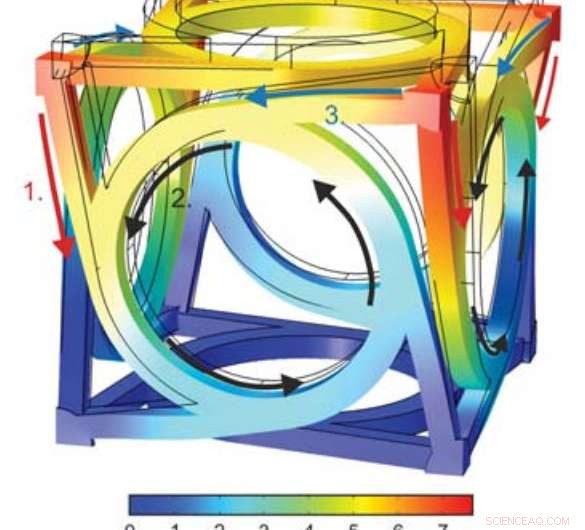
Calculated deformed cell and displacement under uniaxial loading. The arrows aid the discussion of the mechanism: 1. The arms connecting the corners with the rings move downward. 2. This motion leads to a rotation of the rings. 3. This rotation exerts forces onto the corners in the plane normal to the pushing axis, resulting in an overall twist of the unit cell around this axis. Credit: (c) Science (2017). DOI: 10.1126/science.aao4640
(Phys.org)—A trio of researchers with Karlsruhe Institute of Technology in Germany and Université de Bourgogne Franche-Comté in France has developed a metamaterial that twists either to the right or the left in response to a straight, solid push. In their paper published in the journal Science, Tobias Frenzel, Muamer Kadic, and Martin Wegener describe how they came up with the metamaterial and offer some ideas on the ways it might be put to use. Corentin Coulais with the University of Amsterdam offers a Perspective piece on the work done by the team (and some background on how linear elasticity applies to all materials and the foundation of solid mechanics) in the same journal issue.
With normal materials, whether natural or man-made, applying a linear force typically causes the material to expand at a right angle relative to the applied force. In this new effort, the research trio has created a metamaterial that instead twists either right or left.
To create such a material, the researchers used numerical modeling to come up with a cubic form for a cell unit—when such units were configured together, the team found, they would twist when a force was applied. To test their model, the team printed out an actual structure using a 3-D laser. Each cell, the team notes, was made with rings in its faces that led to a rotational effect, with the corners of the cell pulling back around them. Testing showed that the metamaterial could deform at a rate of more than 2 percent per percentage of shortening.
The researchers found that making the cells smaller and using a larger number of them to create a structure of the same size resulted in an increase in stiffness and a smaller amount of twisting. This, they note, lies in sharp contrast to how materials normally behave under classical continuum mechanics—where there would be no twisting and the degree of stiffness would normally be independent of scale. They note further that a metamaterial with twisting properties could lend itself to a wide variety of optical applications, such as in devices that guide force fields or other types of waves around an obstacle.
© 2017 Tech Xplore