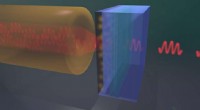
* Change in Speed: Light travels at different speeds in different materials. It moves fastest in a vacuum (like space), and slower in denser materials like water or glass. When light crosses the boundary between two materials, its speed changes.
* Bending of Light: The change in speed causes the light to bend or refract. The amount of bending depends on the angle at which the light hits the boundary and the difference in the materials' refractive indices (a measure of how much light slows down in that material).
* Snell's Law: This law mathematically describes the relationship between the angle of incidence (the angle at which light hits the boundary), the angle of refraction (the angle at which light bends after passing through the boundary), and the refractive indices of the two materials.
Here are some real-world examples of refraction:
* Seeing through water: Light bends as it moves from air into water, causing objects submerged in water to appear shifted and distorted.
* Rainbows: Sunlight is refracted and reflected by raindrops, separating the light into its different colors.
* Lenses: Lenses are designed to bend light in a specific way, focusing it for vision correction or magnifying objects.
Additionally:
* Reflection: Some light can also be reflected at the boundary between two materials, bouncing back into the original material.
* Absorption: Some light can be absorbed by the material, converting its energy into heat.
Understanding refraction is crucial in various fields, including optics, photography, and even astronomy. It explains how telescopes work, how our eyes perceive the world, and even how rainbows form.