1. Spin Magnetic Moment:
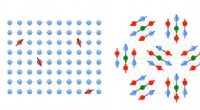
* Electron Spin: Electrons are not just point charges; they also have an intrinsic property called spin. Imagine an electron spinning on its axis, generating a tiny current loop.
* Current Loop: This spinning charge creates a magnetic dipole moment, just like a tiny bar magnet.
* Direction: The direction of the spin magnetic moment is defined by the electron's spin angular momentum, which is quantized (meaning it can only take on specific values).
* Important Note: Electron spin is a fundamental property, not just a literal spinning motion. It's a quantum mechanical concept.
2. Orbital Magnetic Moment:
* Electron Orbit: Electrons in an atom don't just stay still; they orbit the nucleus. This orbital motion also creates a tiny current loop.
* Current Loop: This orbital motion, like the spin, generates a magnetic dipole moment.
* Direction: The direction of the orbital magnetic moment is determined by the electron's orbital angular momentum, which is also quantized.
* Important Note: The orbital magnetic moment is often smaller than the spin magnetic moment for many atoms.
Total Magnetic Moment:
The total magnetic moment of an atom is the vector sum of the spin and orbital magnetic moments of all its electrons.
Key Points:
* Quantum Nature: Both spin and orbital magnetic moments are quantized, meaning they can only take on specific discrete values.
* Magnetic Field: The magnetic moment of an electron creates a magnetic field that can interact with external magnetic fields.
* Applications: Understanding the magnetic moment of electrons is crucial in many fields, including:
* Materials Science: Explaining magnetic properties of materials like ferromagnets.
* Chemistry: Understanding chemical bonding and spectroscopy.
* Nuclear Physics: Investigating nuclear magnetic moments.
* Medical Imaging: Magnetic resonance imaging (MRI).
Let me know if you'd like more detail on any of these aspects!