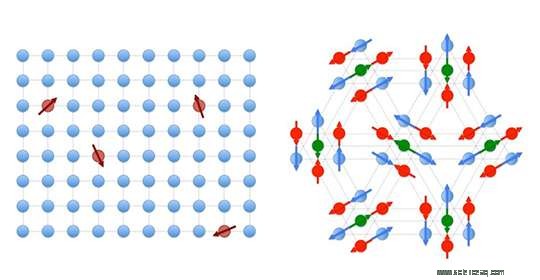
Fig. 1: Schematic illustrations of spin configurations in (left) spin-glass and (right) spin-jam. Due to the random inter-spin interactions, the resulting lowest-energy spin state is randomly ordered for the spin glass, whereas it consists of a number of highly degenerated but well ordered configurations in spin-jam. Credit: Tohoku University
An international team of researchers has revealed the intricate relation between how the systems remember their past and their complex energy landscapes.
Understanding how memory emerges from a complex network of neurons in our brain remains a challenging task in cognitive science. Memory also arises in physical systems with complex energy landscapes such as glasses, disordered magnets, and social networks. Now, an international team of researchers has revealed the intricate relation between how the systems remember their past and their complex energy landscapes.
The findings, published in the journal Proceedings of the National Academy of Sciences of the U.S., show that two magnetic glassy states, called spin glass and spin jam (Fig. 1), exhibit distinct memory effects; a stronger memory for the spin glass and a weaker memory for the spin jam.
The research also revealed by Monte Carlo simulations that the characteristics of how they remember can be accounted for by two distinct energy landscapes; a fractal rugged funnel-like energy landscape for the spin glass and a non-fractal non-hierarchical energy landscape with rough flat bottom for the spin jam.
Their findings illustrate that a combination of experimental and computational works can directly probe the intricate relation between memory and energy landscape, which is essential in understanding the nature of the intrinsic slow dynamics in glassy states.