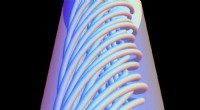
* Sound waves are longitudinal waves: This means the particles in the medium (air in this case) vibrate back and forth *parallel* to the direction the wave travels.
* Compression and Rarefaction: As a sound wave travels, it creates regions of high pressure (compressions) where the air molecules are squeezed together, increasing the density. It also creates regions of low pressure (rarefactions) where the molecules are spread out, decreasing the density.
* Alternating Pattern: These compressions and rarefactions occur in a repeating pattern, so the density at a given point in the air fluctuates as the sound wave passes by.
Think of it like this: Imagine a long spring. If you push one end, you create a compression (high density). If you pull the end, you create a rarefaction (low density). A sound wave is like a series of pushes and pulls moving down the spring, causing alternating regions of high and low density.