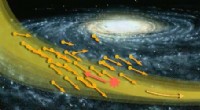
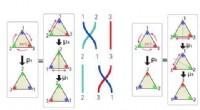
* Random Motion: Particles in a gas or liquid are constantly moving in random directions. They collide with each other and with the walls of their container, changing their direction with each collision. This is called Brownian motion.
* Temperature and Speed: The higher the temperature of a substance, the faster its particles move. This means they collide more frequently and change direction more often.
* Diffusion: Particles naturally move from areas of high concentration to areas of low concentration. This movement is driven by random motion and collisions, resulting in a spread of particles over time.
* Currents and Flows: In liquids and gases, particles can move in a more directed way due to currents or flows. For example, a river current carries water molecules in a specific direction.
* External Forces: External forces like wind, gravity, or magnetic fields can influence the direction of particle movement. For example, gravity pulls objects down, and a magnetic field can direct the movement of charged particles.
In summary, particle movement is generally random but can be influenced by factors like temperature, concentration, currents, and external forces.