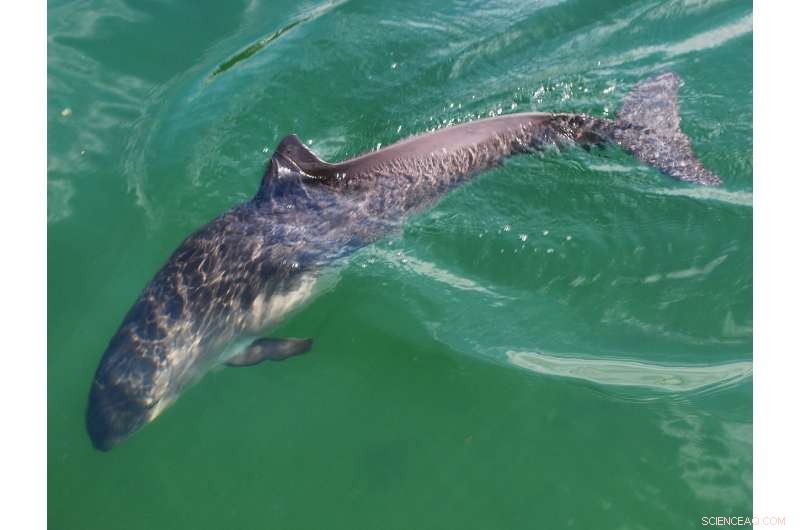
The Harbor Porpoise (Phocoena phocoena) is one of six species of porpoise. Credit: Erik Christensen/Wikipedia.
(Phys.org)—A team of researchers in China has solved the mystery of how porpoises are able to locate tiny prey using sonar with wavelengths that seem too large to be of much use in such applications. In their paper published in the journal Physical Review Applied, the group explains studying the sonar signal-generating parts of porpoise anatomy and what they found by doing so.
Dolphins and porpoises are known to use echolocation to find their way around underwater and to spot prey and predators alike. Their echolocation abilities involve producing high-frequency directional acoustic waves that bounce off objects, which the dolphins read as they come back. Scientists have been studying their sonar abilities for many years because of how well it works—their biological systems are far superior to technologies we humans have devised. In this new effort, the researchers claim to have resolved one of the mysteries of the small-toothed whales known as finless porpoises—how they use large wavelengths to "see" small prey.
Prior research has shown that the sounds produced by porpoises and other cetaceans are generated in the forehead. The sounds that are echoed back are received by nerves in the jaw that pass on information to the brain. To gain an even better understanding of how the porpoises generate their signals, the researchers used computer tomography to get a better look at the creature's forehead. They discovered that the forehead was actually far more complex than has been thought, and that several parts work together to adjust sonic beams as they are emitted. This, they note, allows an individual porpoise to expand the beam for discerning small nearby objects.
The researchers found that the unique physical layout of bone, air sacs and muscle in the forehead was arranged in such a way to allow fine-tuning the acoustic field. They refer to the structure as a metamaterial because it can be altered on demand. They found that a porpoise can tune its beam to become narrower or wider depending on what it wants to detect.
© 2017 Phys.org