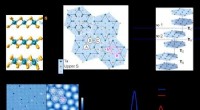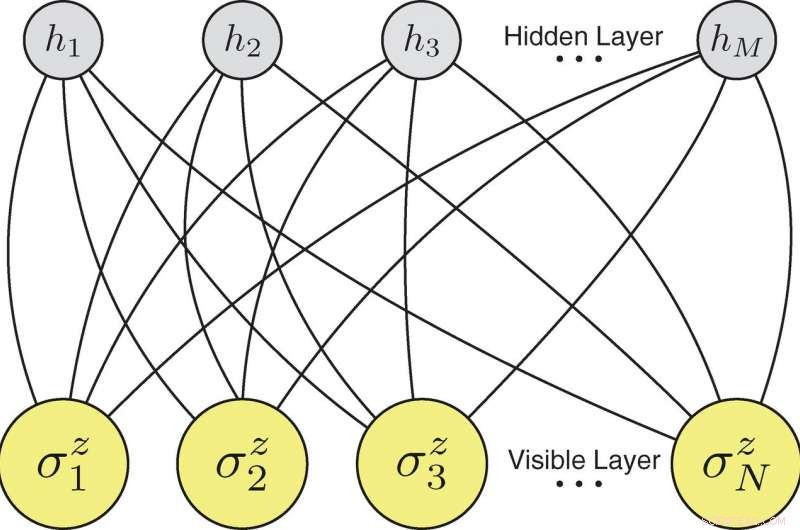
Artificial neural network encoding a many-body quantum state of N spins. Credit: (c) Science 10 Feb 2017: vol. 355, Issue 6325, pp. 602-606
(Phys.org)—A pair of physicists with ETH Zurich has developed a way to use an artificial neural network to characterize the wave function of a quantum many-body system. In their paper published in the journal Science, Giuseppe Carleo and Matthias Troyer describe how they coaxed a neural network to simulate some aspects of a quantum many-body system. Michael Hush with the University of New South Wales offers a Perspectives piece on the work done by the pair in the same journal issue and also outlines the problems other researchers have faced when attempting to solve the same problem.
One of the difficult challenges facing physicists today is coming up with a way to simulate quantum many-body systems, i.e., showing all the states that exist in a given system, such as a chunk of matter. Such systems grow complicated quickly—a group of just 100 quantum particles, for example, could have as many as 1035 spin states. Even the most powerful modern computers very quickly become overwhelmed trying to depict such systems. In this new effort, the researchers took a different approach—instead of attempting to calculate every possible state, they used a neural network to generalize the entire system.
The pair began by noting that the system used to defeat a Go world champion last year might be modified in a way that could simulate a many-body system. They created a simplified version of the same type of neural network and programed it to simulate the wave function of a multi-body system (by using a set of weights and just one layer of hidden biases). They then followed up by getting the neural network to figure out the ground state of a system. To see how well their system worked, they ran comparisons with problems that have already been solved and report that their system was better than those that rely on a brute-force approach.
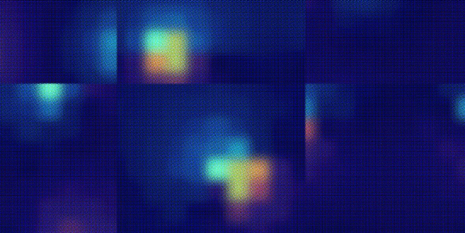
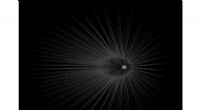
The neural network detects specific patterns in the quantum system. In this case, the network correctly recognises that atoms with an opposite spin tend to pair up. Credit: ETH Zurich / G. Carleo
The system was a proof-of-concept rather than an actual tool for use by physicists, but it demonstrates what is possible—large efforts, as Hush notes, that involve more hidden biases and weights could result in a tool with groundbreaking applications.
© 2017 Phys.org