The bending of light due to gravity was predicted by Albert Einstein's theory of general relativity and has been extensively confirmed through various observations. Some key aspects of how photons behave in the presence of gravity include:
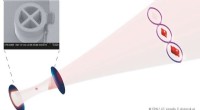
1. Gravitational Lensing: Gravitational lensing occurs when light from distant sources passes through the gravitational field of a massive object. The massive object acts as a gravitational lens, bending and distorting the light's path. This effect is more pronounced for objects with a stronger gravitational field.
2. Deflection of Light: The deflection of light by gravity was one of the key predictions of general relativity. It states that light rays passing near a massive object are deflected toward the object. This deflection is proportional to the mass of the object and inversely proportional to the square of the distance from the object.
3. Gravitational Time Dilation: Photons, like all other particles, are affected by gravitational time dilation. As photons travel through a gravitational field, they experience a slowing down of time relative to observers in a weaker gravitational field. This time dilation leads to various effects, such as gravitational redshift, where the wavelength of light increases as it moves towards a massive object.
4. Frame Dragging: Frame dragging is a phenomenon predicted by general relativity that describes the way in which the rotation of a massive object drags the fabric of spacetime around it. This has an effect on the paths of photons passing near the rotating object, causing them to be deflected in a specific manner.
5. Black Hole Effects: In the vicinity of black holes, the gravitational field is extremely intense, and the effects on photons become even more pronounced. The bending of light near a black hole is so significant that it can create multiple images of distant objects, known as gravitational mirages. Additionally, photons can be captured by the gravitational pull of a black hole, leading to the formation of photon spheres and the eventual fall of photons into the black hole.
The behavior of photons in the presence of gravity has profound implications for our understanding of the universe and has been a subject of extensive study in astrophysics and cosmology. By observing and analyzing the effects of gravitational lensing and other phenomena, scientists gain insights into the mass distribution, structure, and evolution of galaxies, black holes, and the large-scale universe.