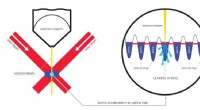
Diffraction is the spreading out of waves as they pass through an aperture or around an obstacle. The amount of diffraction depends on the wavelength of the wave and the size of the aperture or obstacle. Shorter wavelengths diffract less than longer wavelengths, so diffraction decreases as frequency increases.
For example, visible light has a shorter wavelength than microwaves, so visible light diffracts less than microwaves. This is why we can see objects that are much smaller than the wavelength of visible light, but we cannot see objects that are much smaller than the wavelength of microwaves.