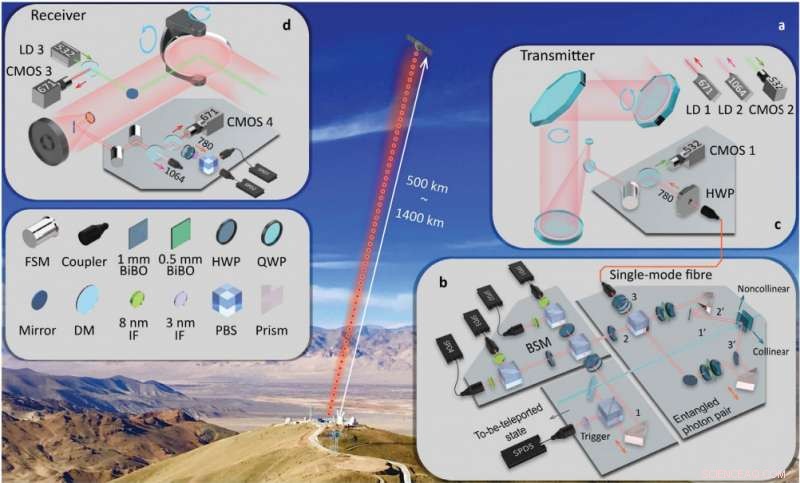
Overview of the set-up for ground-to-satellite quantum teleportation of a single photon with a distance up to 1400 km. Credit: arXiv:1707.00934 [quant-ph]
(Phys.org)—Two teams of researchers in China have advanced the distance that entangled particles can be used to send information, including encryption keys. In their papers, both uploaded to the arXiv preprint sever, the two groups outline their work and suggest their achievement represents an essential step toward the development of a global-scale quantum internet.
Quantum entanglement is the shared state of two separate particles—what happens to one happens to the other. Scientists have not yet figured out how this occurs, but they have learned how to create entangled particles on demand, typically by firing a laser through a crystal. As physicists learn more about entangled particles, they've designed more experiments to take advantage of their unique properties. One such area of research involves using them to build quantum networks. Such networks would be much faster than anything we have now, and they would also be much more secure because of the nature of entangled particles—disruptions to encryption keys, for example, could be instantly noted, allowing for prevention of hacking. In this new effort, the researchers have extended the entanglement distance of two particles—one on the surface of the Earth and the other in space, courtesy of a satellite. They have also shown that it is possible to send entangled encryption keys from a satellite to an Earth-based receiving station.
In the first experiment, the research team transferred the properties of an entangled particle housed in a facility in Tibet to its partner, which was beamed to a satellite passing overhead, far surpassing the distance record by other researchers. In this case, the information transfer occurred with photons that were approximately 500 to 1,400 kilometers apart, depending on the location of the satellite.
In the second experiment, equipment aboard a satellite created a random string of numbers to represent an encryption key. The key was then beamed to an Earth station as part of an entangled photon stream that used polarization as a means of transmission security.
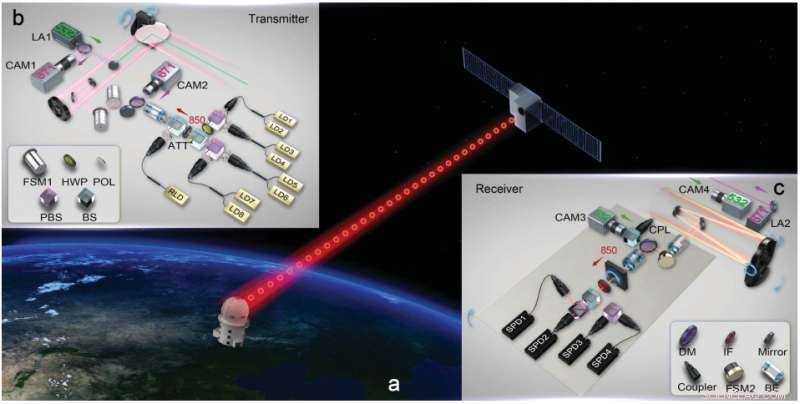
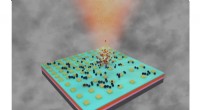
Illustration of the experimental set-up from "Satellite-to-ground quantum key distribution" arXiv:1707.00542 [quant-ph]
© 2017 Phys.org