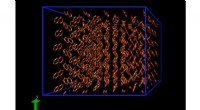
When a force is applied to a metal, the metal's atoms are displaced from their original positions. When the force is removed, the atoms return to their original positions. This is known as elastic deformation.
The amount of deformation that occurs depends on the magnitude of the applied force and the material's Young's modulus, which is a measure of its stiffness. A material with a higher Young's modulus is stiffer and will deform less under a given force.
The ability of a metal to undergo elastic deformation is important for many engineering applications. For example, springs are made of materials that have a high Young's modulus so that they can store and release energy when compressed or stretched.