Apparatus:
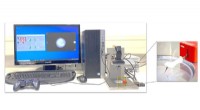
- Cantilever beam apparatus with a well-defined specimen dimension.
- Set of standard masses.
Procedure:
1. Preparation:
- Ensure that the cantilever beam is securely clamped and the setup is stable.
- Attach a mass hanger to the free end of the cantilever beam.
- Attach a dial gauge or other displacement measuring device to the free end of the cantilever beam to measure deflection.
- Zero the displacement measuring device.
2. Loading:
- Gradually add masses to the mass hanger in small known increments, starting with a small mass.
- Record the corresponding deflection for each mass increment.
- Continue adding masses and recording deflections until the deflection becomes significant (e.g., several millimeters)
3. Data Collection:
- Plot a graph of deflection (y-axis) versus the corresponding load (x-axis) in newtons (N) or grams-force (gf).
4. Calculations:
- Calculate the slope of the linear portion of the graph. The slope represents the spring constant (k) of the apparatus.
- The apparatus modulus (Y) is calculated using the formula:
Y = (L^3 * k)/ (3 * I)
Where:
L is the length of the cantilever beam
k is the spring constant
I is the moment of inertia of the beam's cross-section.
Analysis:
- The apparatus modulus (Y) is expressed in units of Pascals (Pa) representing the stiffness of the experimental setup.
- A higher apparatus modulus indicates a stiffer setup, meaning that it resists deformation more effectively under applied loads.
- The accuracy of the apparatus modulus determination depends on factors such as the precision of the displacement measurements and the accuracy of the mass measurements.
Note:
- Perform multiple trials and calculate the average apparatus modulus to improve accuracy.
- Repeat the experiment with different cantilever beams or setups to compare their stiffness or analyze the effects of different experimental conditions on the apparatus modulus.
- Ensure proper experimental technique, including careful handling and alignment of components, to obtain reliable results.