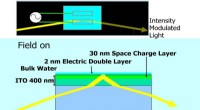
1. Electron Transfer: The atom attracts the free electron due to the electrostatic force between the positively charged ion and the negatively charged electron. The electron moves towards the atom and fills the vacant electron shell.
2. Neutralization: As the atom gains the electron, it becomes electrically neutral again. The positive charge of the ion is canceled out by the negative charge of the electron, resulting in a neutral atom.
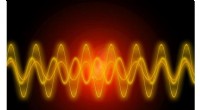
3. Energy Release: During the process of electron transfer, a certain amount of energy is released in the form of electromagnetic radiation. This energy is emitted as a photon of light, typically in the visible, infrared, or ultraviolet spectrum. The wavelength of the emitted light corresponds to the energy difference between the initial and final energy levels of the electron.
4. Quantum Mechanical Explanation: In quantum mechanics, electron transfer is described as a transition of the electron from the energy level of the free electron to a lower energy level in the atom. This transition is governed by the principles of quantum mechanics and is influenced by factors such as the atomic orbitals and the spin of the electron.
5. Chemical Bonding: The process of electron transfer plays a crucial role in chemical bonding. When atoms gain or lose electrons, they achieve a more stable electron configuration, which leads to the formation of chemical bonds. This is the basis of ionic and covalent bonding, which are the two primary types of chemical bonds.
6. Chemical Reactions: Electron transfer is fundamental to many chemical reactions. It occurs in various processes such as oxidation-reduction reactions, where atoms or molecules exchange electrons, leading to changes in their oxidation states. Redox reactions are essential in numerous chemical processes, including combustion, respiration, and industrial processes.
In summary, when an atom that has lost an electron gains an electron, the atom becomes electrically neutral again and releases energy in the form of light. This process is crucial in achieving electron stability, forming chemical bonds, and driving chemical reactions.