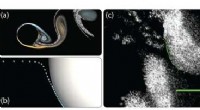
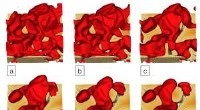
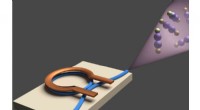
The flow of fluid through small tubes, such as blood vessels and intestines, is essential for many physiological processes. However, the behavior of fluid flowing through these tubes is complex and not fully understood. Engineers are working to develop models and simulations that can predict how fluid will flow through these tubes and how it will interact with the tiny hairs that line them.
The Challenge
The challenge in predicting how fluid will flow through small tubes is that the flow is often turbulent. Turbulent flow is characterized by random and chaotic fluctuations in velocity and pressure. This makes it difficult to predict the exact path that a fluid particle will take as it flows through a tube.
In addition, the tiny hairs that line blood vessels and intestines can also affect the flow of fluid. These hairs, known as cilia, are constantly waving back and forth, which can create additional turbulence and make the flow even more difficult to predict.
The Models
Engineers are developing a variety of models and simulations to predict how fluid will flow through small tubes and how it will interact with cilia. These models range from simple analytical models to complex computational simulations.
One common type of analytical model is the Poiseuille flow model. This model assumes that the flow is laminar, which means that it is smooth and orderly. The Poiseuille flow model can be used to predict the pressure drop and velocity of fluid flowing through a tube.
Another type of analytical model is the Womersley flow model. This model takes into account the effects of pulsatile flow, which is the type of flow that occurs in blood vessels. The Womersley flow model can be used to predict the velocity and shear stress of fluid flowing through a tube.
Computational simulations are another powerful tool for predicting how fluid will flow through small tubes. These simulations use numerical methods to solve the governing equations of fluid mechanics. Computational simulations can be used to model complex geometries and flow conditions that are not easily amenable to analytical models.
The Applications
The models and simulations that engineers are developing to predict how fluid will flow through small tubes and how it will interact with cilia have a variety of applications. These applications include:
* Designing medical devices, such as stents and catheters, that are used to treat cardiovascular disease.
* Developing new drugs that can be delivered more effectively to specific parts of the body.
* Understanding how the flow of fluid through the intestines affects nutrient absorption.
* Predicting the behavior of fluid flowing through microfluidic devices, which are used in a variety of applications, such as drug testing and chemical analysis.
The work that engineers are doing to predict how fluid will flow through small tubes and how it will interact with cilia is essential for advancing our understanding of many physiological processes and for developing new medical devices and treatments.