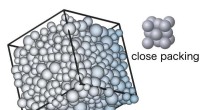
The structure of a particle packing can be characterized by its porosity and coordination number. The porosity is the fraction of the total volume that is not occupied by particles. The coordination number is the average number of particles that are in contact with a given particle.
The packing of particles in a confined space is affected by a number of factors, including the shape of the particles, the size of the particles, and the amount of confinement.
For spherical particles, the densest packing is the face-centered cubic (fcc) structure. In the fcc structure, each particle is in contact with 12 other particles.
For non-spherical particles, the densest packing is often not known. However, there are a number of methods that can be used to estimate the densest packing.
One method for estimating the densest packing is the random close packing (rcp) method. The rcp method involves generating a large number of random particle configurations and then selecting the configuration with the lowest porosity.
Another method for estimating the densest packing is the Monte Carlo method. The Monte Carlo method involves simulating the packing of particles by randomly moving particles and then accepting or rejecting moves based on the energy of the system.
The packing of particles in a confined space can be used to design materials with specific properties. For example, materials with a high porosity can be used as filters, while materials with a high coordination number can be used as strong materials.
The packing of particles in a confined space is a complex problem that is still not fully understood. However, there are a number of methods that can be used to estimate the densest packing and to design materials with specific properties.