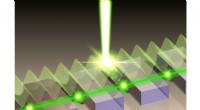
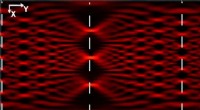
Consider the famous double-slit experiment, which demonstrates the wave-particle duality of light. In this experiment, a beam of light passes through two closely spaced slits and creates an interference pattern on a screen behind the slits. The pattern can be explained by considering light as a wave that passes through both slits and interferes with itself.
However, if we place a detector at one of the slits to determine which slit the light particle passes through, the interference pattern disappears. This suggests that the act of observing the particle's path causes it to behave more like a particle and less like a wave.
Similarly, in quantum computing, superposition and entanglement allow for parallel processing and complex calculations that are impossible with classical computers. Quantum algorithms, like Shor's algorithm for factoring large numbers and Grover's algorithm for searching unsorted databases, take advantage of these quantum properties to achieve exponential speedups over classical algorithms.
While the details of quantum phenomena may seem counterintuitive compared to everyday experiences, they have been extensively studied and experimentally verified. Quantum mechanics has laid the groundwork for advancements in various fields, such as quantum computing, quantum cryptography, quantum sensing, and quantum metrology.
Although the complete understanding of a quantum system provides more information and allows for more precise predictions, the principle that partial information can still yield valuable and accurate results is a fundamental characteristic of the quantum world.