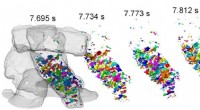
When glass is subjected to a force, the pieces start to slide past each other, creating tiny cracks. These cracks then grow and eventually cause the glass to break. The new theory predicts how the cracks will grow and how the glass will break into pieces.
The researchers tested their theory by simulating the breaking of glass using a computer model. The model showed that the glass broke into pieces that were similar in shape to those seen in real-world experiments.
The new theory could have implications for the design of glass products. By understanding how glass breaks, engineers can design products that are less likely to break or that break in a way that is less dangerous.
In addition, the new theory could help scientists understand how other materials break. For example, the theory could be used to understand how ceramics, plastics, and metals break.
The research was conducted by a team of scientists from the University of California, Santa Barbara, and the University of Twente in the Netherlands.