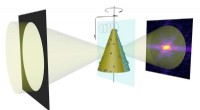
Stochastic resonance: In certain systems, the presence of noise can help amplify weak signals. This phenomenon is known as stochastic resonance and occurs when the noise introduces randomness into the system's dynamics, allowing a weak signal to become detectable. The noise helps the system overcome energy barriers and increases the signal-to-noise ratio.
Signal-to-noise ratio improvement: Noise can sometimes make a weak signal more salient by providing a contrast or reference point. When a weak signal is superimposed on a background of noise, the difference between the signal and the noise can become more noticeable. This is particularly true when the frequency or pattern of the weak signal differs significantly from the noise.
Temporal integration: Noise can facilitate the detection of weak signals through temporal integration. By integrating the signal over time, the weak signal can accumulate and become more noticeable. In contrast, noise may average out over time, making it less disruptive to the detection of the weak signal.
Nonlinear interactions: Noise can interact with a weak signal in nonlinear ways, leading to enhanced sensitivity. Nonlinear systems can amplify or modulate the weak signal, extracting information that would be difficult to detect in the absence of noise.
Resonance and frequency matching: Noise can contain a range of frequencies, some of which may match the frequency of the weak signal. This can lead to constructive interference, enhancing the weak signal's detectability.
It's important to note that the beneficial effects of noise on signal detection depend on the specific system and conditions. In some cases, excessive noise can obscure weak signals or reduce sensitivity. Finding the optimal level of noise for enhancing sensitivity requires careful analysis and experimentation.