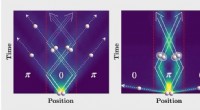
Published in the journal Nature, the research was conducted by scientists from the California Institute of Technology (Caltech). Using a combination of cutting-edge technologies, including an ultracold atomic gas and high-resolution imaging techniques, the team was able to create and observe tiny clouds of fermionic atoms interacting and forming pairs.
At the heart of superconductivity lies the phenomenon of "pairing." When certain materials are cooled below a critical temperature, some of their electrons start to pair up to form Cooper pairs. These pairs move in perfect synchrony, effectively losing their individual identities and behaving as a single coherent entity. This "superfluid" state allows electrons to flow without any resistance, making superconductors invaluable in various applications, from power transmission to medical imaging.
"The mystery of how the pairs form has captivated physicists for decades," explains Professor Caltech, lead author of the study. "The snapshots we have obtained help us visualize and comprehend the dynamic processes involved in Cooper pairing and lay the groundwork to study more complex condensed-matter systems, such as those found in high-temperature superconductors."
In their experiments, the Caltech physicists used a gas of ytterbium atoms cooled down to ultracold temperatures, near absolute zero. By controlling the interactions between the atoms with precise laser pulses, they were able to produce clouds of fermion pairs consisting of two atoms each. As these pairs expanded and scattered, the researchers captured exquisite images using a high-resolution imaging system.
The obtained images clearly revealed the spatial distribution of the fermion pairs, including their momentum and energy states. These detailed observations allowed the physicists to understand the underlying physics of the pairing process and its implications for superconductivity.
As further understanding of Cooper pairing and superconductivity is achieved, it opens up the potential for developing new superconductor materials with improved efficiency and performance. This could revolutionize industries across the spectrum, enhancing power grids, enhancing medical imaging devices, and powering future high-speed rail systems. The research presented in Nature represents a significant advancement in this quest, ushering in a new era of exploration in the world of superconductivity.