Using the Summit supercomputer at the Oak Ridge Leadership Computing Facility (OLCF), a DOE Office of Science User Facility at ORNL, the researchers simulated the effects of adding extra electrons to a copper-oxide lattice at extremely cold temperatures.
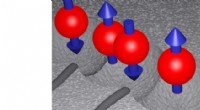
By studying the changes in the material's electronic properties, the team found that the addition of electrons suppressed antiferromagnetism—the tendency of electron spins to align in opposite directions—and promoted the formation of Cooper pairs, which are responsible for superconductivity, allowing electricity to flow without losing energy.
"This is the first theoretical work that explicitly and self-consistently links these key behaviors," said ORNL's B. Sriram Shastry. "The findings from our simulations suggest that the unconventional superconducting state found in copper oxides could be the result of a competition between antiferromagnetism and superconductivity."
According to Shastry, the team's next steps are to study how the material's properties change with temperature and to investigate the effects of disorder on superconductivity. "This work brings us closer to a more fundamental understanding of superconductors, which could lead to new materials with even higher transition temperatures," he said.
The research was published in Physical Review B.