In a study published in the journal Nature, the team reports on the results of an experiment that measured the difference in the masses of matter and antimatter. The experiment was conducted using the Large Hadron Collider (LHC), the world's largest and most powerful particle accelerator.
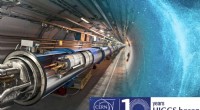
The LHC is a 27-kilometer (17-mile) circular particle accelerator that smashes protons together at extremely high energies. When protons collide, they produce a shower of particles, including matter and antimatter particles. The team of physicists used the LHC to measure the difference in the masses of these particles.
The team found that matter particles are slightly heavier than antimatter particles. This difference is very small, but it is enough to explain why there is more matter than antimatter in the universe.
The universe is thought to have started with an equal amount of matter and antimatter. However, shortly after the Big Bang, the universe underwent a phase transition that caused the matter and antimatter particles to separate. This separation is thought to have been caused by a slight difference in the masses of matter and antimatter particles.
The team of physicists at CERN has now measured this difference in the masses of matter and antimatter particles. This measurement provides strong evidence for the theory that the universe underwent a phase transition that caused the matter and antimatter particles to separate.
The study also has implications for the search for dark matter. Dark matter is a mysterious substance that makes up about 27% of the universe. Dark matter does not interact with light, so it is very difficult to detect. However, the team of physicists at CERN has found that dark matter could be made up of a new type of particle that has a very small mass.
The study by the team of physicists at CERN has shed light on one of the biggest mysteries in physics. The measurement of the difference in the masses of matter and antimatter particles provides strong evidence for the theory that the universe underwent a phase transition that caused the matter and antimatter particles to separate. The study also has implications for the search for dark matter.