Mixing and Reaction-Diffusion Systems:
Turbulence can enhance mixing in chemical reaction-diffusion systems, leading to the formation of intricate patterns. The interplay between turbulent flow and chemical reactions creates concentration gradients and reaction fronts that evolve into various patterns, such as stripes, spots, or spirals. This concept is widely studied in the field of chemical pattern formation.
Taylor-Couette Flow:
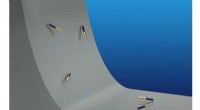
In Taylor-Couette flow, a rotating cylinder enclosed within a stationary outer cylinder generates a shear flow. When the rotation rates exceed a critical value, turbulence sets in, resulting in the formation of Taylor vortices. These vortices create regular hexagonal patterns known as Taylor cells, illustrating how turbulence can self-organize into geometric structures.
Rayleigh-Bénard Convection:
Rayleigh-Bénard convection occurs when a fluid layer heated from below becomes unstable and forms convective rolls. As the temperature difference increases, turbulence can arise within the rolls, leading to the emergence of complex patterns, including hexagonal cells, square lattices, and even chaotic structures.
Plasma Physics:
In plasma physics, turbulence plays a role in generating intricate magnetic field structures in fusion devices. These self-organized patterns, known as turbulence-driven zonal flows, help regulate plasma instabilities and transport, potentially improving the efficiency of fusion reactors.
Atmospheric and Oceanic Phenomena:
Atmospheric and oceanic circulation patterns are influenced by turbulence. For instance, large-scale weather systems, such as cyclones and anticyclones, form and evolve due to the interaction between turbulence and other atmospheric processes. Similarly, ocean currents and eddies are shaped by turbulent mixing and interactions with topography.
Material Science and Engineering:
Turbulence can be harnessed to create patterns in materials science and engineering. By controlling the flow conditions during processes like solidification or crystallization, it is possible to induce the formation of desired microstructures, leading to improved material properties and performance.
Biological Systems:
Turbulence-generated patterns are also found in biological systems. For example, certain bacteria use turbulence to form intricate biofilm structures, which enhance their survival and adaptability. Moreover, turbulence can influence cell migration and differentiation, suggesting its role in biological pattern formation and development.
Understanding and leveraging the mechanisms behind turbulent pattern formation has profound implications in various fields, including physics, chemistry, engineering, biology, and environmental science. By exploiting the interplay between turbulence and other physical processes, scientists and engineers can design systems that harness the power of turbulence to create useful and fascinating patterns.