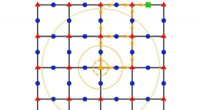
Here's how the overlap of quantum states is computed:
Consider two quantum states represented by their wave functions, \(\psi_1(x)\) and \(\psi_2(x)\). The overlap between these states is given by the overlap integral:
$$ \langle \psi_1 | \psi_2 \rangle = \int_{-\infty}^\infty \psi_1^*(x) \psi_2(x) \ dx $$
where \(\psi_1^*(x)\) is the complex conjugate of \(\psi_1(x)\).
The overlap integral calculates the weighted integral of the product of the two wave functions over the entire domain. The result is a complex number, and its absolute value squared gives the probability that a particle in state \(\psi_1\) will be found in state \(\psi_2\) if measured.
Key points to note:
- The overlap integral is a measure of the similarity between two quantum states. It ranges from 0 to 1, where 0 indicates orthogonal states (completely different) and 1 indicates identical states.
- For normalized wave functions, the overlap integral represents the probability amplitude for finding a particle in state \(\psi_1\) while it is in state \(\psi_2\).
- Overlapping quantum states plays a crucial role in quantum interference, entanglement, and other fundamental quantum phenomena.
- In quantum computing, overlapping states are utilized in operations such as quantum state tomography, quantum teleportation, and quantum error correction.
- Calculating the overlap integral often involves numerical integration methods for complicated wave functions.
Examples:
- For two identical wave functions, the overlap is 1:
$$ \langle \psi | \psi \rangle = \int_{-\infty}^\infty |\psi(x)|^2 \ dx = 1$$
- For orthogonal states, the overlap is 0:
$$ \langle \psi_1 | \psi_2 \rangle = \int_{-\infty}^\infty \psi_1^*(x) \psi_2(x) \ dx = 0 $$
These examples illustrate the basic principles of computing the overlap between quantum states. Real-world applications may require more complex wave functions and integration methods, but the fundamental concept remains the same.