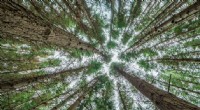
* Competition for sunlight: Forests are dense environments where trees are constantly vying for sunlight. Trees with straight trunks can reach higher into the canopy, giving them access to more sunlight for photosynthesis.
* Shading: Lower branches in dense forests receive very little sunlight, making them less productive and more susceptible to disease. Trees naturally prune these branches, focusing their energy on growing tall and reaching the canopy.
* Natural selection: Over time, trees with straight trunks and fewer lower branches have been more successful in competing for resources. They have survived and reproduced, passing on these traits to future generations.
* Wind: Strong winds can easily snap branches, and trees with lower branches are more vulnerable to damage. Straight trunks are more stable and can withstand the force of winds better.
Exceptions:
* Open forest environments: Trees growing in open forests or areas with less competition may have more branches, as they have more access to sunlight.
* Species-specific adaptations: Some species, like pines, naturally have lower branches that aid in seed dispersal or provide protection from predators.
In summary, the straight trunks and few lower branches of forest trees are a result of natural selection that favors individuals with traits best suited for survival and reproduction in a competitive, shaded environment.