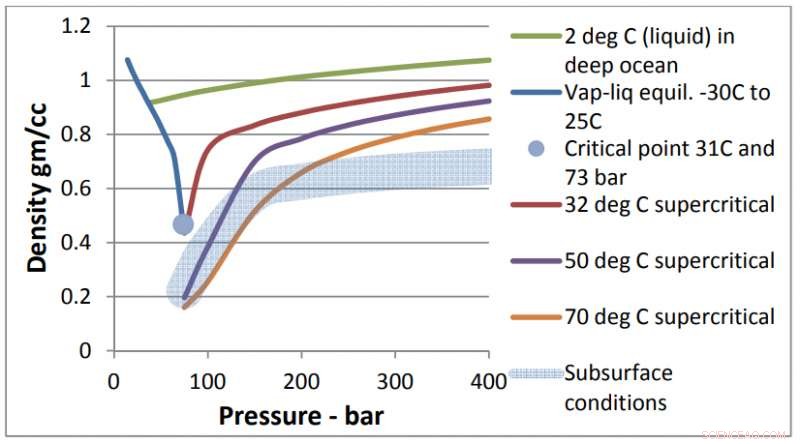
Density vs. pressure for CO2 at subcritical and supercritical conditions. Credit: Energy Procedia (2017). DOI: 10.1016/j.egypro.2017.03.1686
(Phys.org)—New Zealand energy analyst Steve Goldthorpe has published a paper in the journal Energy Procedia suggesting that carbon dioxide pulled from the atmosphere (or scrubbed from coal plant smoke stacks) could be stored permanently in deep ocean trenches. Once there, he notes, the gas would become a liquid denser than ocean water, which would cause it to fall naturally to the ocean floor, creating an underwater lake.
In order to prevent serious changes to our planet, most scientists agree that we need to stop pumping greenhouse gases, particularly carbon dioxide, into the atmosphere—and we should probably start trying to remove at least some of what we have already put there. But where would put it? We cannot just dump it somewhere, because it is a gas and would simply make its way back into the atmosphere. Some have suggested injecting it into spent natural gas wells or other underground vacancies. Goldthorpe suggests that perhaps the ocean would be a better option, noting that at depths of 3000 meters, the density of carbon dioxide is greater than that of ocean water, which means it would sink. Ideally, it would sink into a hole of some sort so that it would not spread across the ocean floor. Ocean trenches, he notes, could serve that purpose. They would fill like an empty bucket with water here on land, creating a lake of carbon dioxide. He adds that it is possible that over a long time period, the carbon dioxide would solidify.
Goldthorpe takes his idea even further by offering some possible sites—he used Google Earth to check for suitable candidates. He notes that Sunda trench, which is 6 kilometers below the surface in an area south of the Indonesian archipelago would be a good choice. He's calculated that it could hold 19 trillion tonnes of liquified carbon dioxide, which, he notes, is more than all of the carbon dioxide that humans have injected into the atmosphere to date. He notes also that the idea is not out of the blue—natural carbon dioxide lakes already exist on the ocean floor. Other possibilities might include the Japanese Ryuky trench or the Puerto Rico trench.
Goldthorpe concludes by acknowledging that much more study would have to be done before serious consideration, particularly to prevent the top portions from spreading or causing an increase in ocean acidity.
© 2017 Phys.org