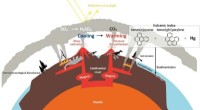
1. Radiometric Dating: Radioactive elements decay at a predictable rate. By measuring the ratio of parent isotopes to daughter isotopes in rocks and fossils, scientists can determine their age. This technique consistently dates Earth's oldest rocks to over 4 billion years old.
2. Fossil Record: The fossil record shows a clear progression of life forms over billions of years. Simple organisms appear first, followed by more complex ones, culminating in the evolution of humans. This pattern is incompatible with a young Earth.
3. Geology: Geological features like mountain ranges, canyons, and plate tectonics take millions of years to form. The vastness of geological time is evident in the layers of rock, erosion patterns, and the distribution of geological features.
4. Astronomy: The age of stars and the universe can be estimated through various astronomical observations. These observations consistently point to a universe that is billions of years old.
5. Ice Cores: Ice cores extracted from glaciers and ice sheets contain layers of ice that reflect past climate conditions. By analyzing these layers, scientists can reconstruct climate history over hundreds of thousands of years.
Young Earth Creationism:
The idea of a young Earth is based on a literal interpretation of certain religious texts. While this belief is held by some, it is not supported by the scientific evidence.
It's important to remember:
* Science is a process of observation, experimentation, and evidence-based reasoning.
* Scientific conclusions are constantly tested and refined as new evidence emerges.
* The vast majority of the scientific community accepts the age of the Earth to be billions of years old.
If you're interested in learning more about the evidence for an old Earth, I encourage you to explore reputable scientific resources.