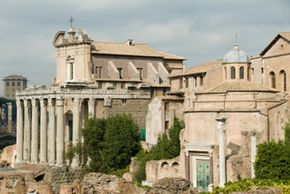
At the height of its power, Rome reached a population of nearly one million people -- the largest city of an empire that stretched from Scotland in the west to the Persian Gulf in the east. A city of that size required enormous planning, and Roman engineers obliged by taking into consideration a number of features that ensured the safety, productivity and well-being of its citizens. They provided systems to dispose of sewage. They built aqueducts to bring water to the city. They built roads to facilitate transportation and communication. They designed and arranged financing for baths, sports arenas and theaters. And they placed, at the heart of the city, a forum where Romans of every class and distinction could gather to socialize, worship and conduct business.
Although ancient Rome finally collapsed, the principles of municipal planning that made the city so splendid and powerful lived on. As other cities grew, they also had to address the myriad problems that arose whenever a large number of people crowded into a relatively small amount of space. Over time, the development process cities undertook -- a process that led to solutions for habitation, communication, education, transportation and more -- became known as urban planning. And the people who guided the work became known as urban planners.
Today, urban planning is one of the most important occupations when you consider how much of the world's population lives in cities and their surrounding areas. In 1800, a little more than 2 percent of the world's population lived in urban areas. By 1900, that number had grown to 45 percent. And by 2010, it is expected to grow to 51.3 percent, according to the United Nations [source: ScienceDaily].
Clearly, effective urban planning will be critical to the success of our planet. But what exactly is it? That's the question this article will answer. We'll look closely at what urban planning is, how long it's been around, what it entails and who provides the services in most cities and towns. We'll also explore the future of urban planning to understand how municipal planning principles used today may be incorporated into cities of the future, including cities that could exist on the moon or Mars. But before we travel into outer space, let's go back to Chicago at the beginning of the 20th century.
Contents The Administration Building at the 1893 World's Columbian Exposition in Chicago, where Daniel Hudson Burnham's City Beautiful movement made its debut.
Stock Montage/Hulton Archive/Getty Images
The Administration Building at the 1893 World's Columbian Exposition in Chicago, where Daniel Hudson Burnham's City Beautiful movement made its debut.
Stock Montage/Hulton Archive/Getty ImagesTo understand Chicago of the early 1900s, consider this observation from Truesdale Marshall, the protagonist of Henry Blake Fuller's novel, "With the Procession:" "[Chicago is a] hideous monster … so pitifully grotesque, gruesome, appalling." Many people, foreigners and Americans alike, felt the same way about most cities in America. By 1910, many cities contained one million residents, but few planned properly for such a population explosion. As a result, cities developed in an ad hoc fashion. This made them shapeless, inefficient and, in many cases, dangerous.
Daniel Hudson Burnham, a Chicago architect, began to address these issues in an approach to urban planning that would become known as the City Beautiful movement. City Beautiful was characterized by the belief that if you improved form, function would follow. In other words, an attractive city would perform better than an unattractive one. Beauty came from what Burnham called "municipal art" -- magnificent parks, highly designed buildings, wide boulevards, and public gathering places adorned with fountains and monuments. Such beautiful additions to the cityscape could not directly address perceived social ills, but they could, at least in Burnham's thinking, indirectly improve social problems by enhancing the urban environment.
Burnham first displayed the City Beautiful principles at the 1893 World's Columbian Exposition in Chicago. His dream city, known as White City, featured large-scale monuments, electriclights and state-of-the-art transport systems. It also removed all visible signs of poverty so that the roughly 27 million visitors who streamed through the exhibition witnessed a true urban utopia.
Burnham then applied City Beautiful ideas to several city designs between 1902 and 1905. He directed plans for Washington, D.C.; Cleveland, Ohio; Manila; and San Francisco, Calif., But the culmination of the movement came in 1906 when Burnham teamed up with Edward Bennett to prepare the Plan of Chicago, the first comprehensive plan for controlled growth of an American city. The Plan encompassed the development of Chicago within a 60-mile radius and called for a double-decker boulevard to better accommodate commercial and regular traffic, straightening of the Chicago River, consolidation of competing rail lines and an integrated park system that encompassed a 20-mile park area along Lake Michigan. Some of these features, such as the twin-level roadway, were firsts in any city, anywhere in the world.
Although the City Beautiful movement was revolutionary in America, it drew upon urban planning ideas used for many years in Europe. In particular, Burnham used Paris as a successful model of urban planning. Planning of Paris began in earnest in the 1600s during the reign of Louis XIV when architects used great foresight to build squares, parks and avenues in areas that were barely settled. As Paris increased its population, it was able to grow into its design. Then, in another era of notable development beginning in the 1850s, Georges Eugéne Haussmann, appointed by Napoleon Bonaparte, began reworking the city, making it more suitable and attractive for the vast numbers of visitors, merchants, manufacturers and residents who filled the city.
Burnham also recognized the contribution of the ancient planners responsible for Athens and Rome, as well as the planning tradition that went back for centuries. In the next section, we'll look at how this tradition manifests itself today in the hands of modern planners.
 Coastal cities, such as Miami, enjoy certain advantages by having access to the ocean. They also face certain challenges, including exposure to hurricanes.
Hulton Archive/Getty Images
Coastal cities, such as Miami, enjoy certain advantages by having access to the ocean. They also face certain challenges, including exposure to hurricanes.
Hulton Archive/Getty ImagesThe goal of planning is to guide the development of a city or town so that it furthers the welfare of its current and future residents by creating convenient, equitable, healthful, efficient and attractive environments. Most urban planners work in existing communities, but some help develop communities -- known as new towns, new cities or planned communities -- from scratch. Either way, urban planners must consider three key aspects of a city as they map out their programs:
The physical environment: A city's physical environment includes its location, its climate and its proximity to sources of food and water. Because drinking water is so crucial, many cities are founded at the head of a river or at the fall line, the point where rivers descend from the regions of older, harder rocks toward the softer sediments of the coastal plain. The rapids that often form at the fall line mark ideal locations for towns and villages to evolve. Coastal cities also have a great advantage in that their accessibility positions them to become important trading centers.
Planners must often consider an area's geologic history to understand the full character of a city. For example, the physical environment of New York City and the surrounding region reflects the culmination of a billion years of geologic activity. Over this great span of time, mountain ranges formed and were worn away. Seaways came and went. Most recently, episodes of continental glaciation covered the area with ice sheets that eventually retreated. All of this activity makes New York City what it is today and affects how it might change in the future.
The social environment: The social environment includes the groups to which a city's residents belong, the neighborhoods in which they live, the organization of its workplaces, and the policies created to impose order. One of the biggest issues in most cities is the inequitable distribution of resources. For example, more than 50 percent of the population of Mumbai and New Delhi (cities in India) live in slums, while in Lagos and Nairobi (cities in Africa), more than 60 percent of households aren't connected to water [source: United Nations Human Settlements Programme]. As a result, the social environment can be a risk factor for disease and mortality as much as individual risk factors.
Planners work with local authorities to make sure residents are not excluded from the benefits of urbanization as a result of physical, social or economic barriers.
The economic environment: All cities work hard to support the retention and expansion of existing local businesses. Primary employers, such as manufacturing as well as research and development companies, retail businesses, universities, federal labs, local government, cultural institutions, and departments of tourism all play strong roles in a city's economy. The programs of an urban planner should encourage partnerships among public agencies, private companies and nonprofit organizations; foster innovation and competitiveness; provide development opportunities and resources to small businesses; and nurture, preserve and promote local arts and creative industries in order to sustain a city's cultural vitality.
As you can imagine, urban planners must do a great deal of research and analysis to fully understand how the physical, social and economic aspects of a city interact. Before they ever put pen to paper, they study:
They also gather input from residents, government officials, politicians, business executives and special groups. Armed with all of this information, planners develop short- and long-term strategic alternatives for solving problems in a coordinated and comprehensive manner. They also show how these programs can be carried out and how much they will cost.
All of these details are captured in a formal document known as a comprehensive plan or a master plan. In the next section, we'll take a look at a typical plan.
 The modes of transportation offered by a city help to define its character.
Tim Boyle/Getty Images
The modes of transportation offered by a city help to define its character.
Tim Boyle/Getty ImagesAny municipality, from small village to sprawling metropolis, can have a master plan. Small communities will hire a private planning firm to prepare a plan and submit it to the local government for approval. In big cities, the department of city planning prepares the master plan.
The plan itself is a document, sometimes hundreds of pages long, that shows a community as it is and recommends how it should exist in the future. It often contains diagrams, aerial photos, maps, reports and statistical information that support the planner's vision.
A typical master plan addresses the following:
Public support of a master plan, no matter how comprehensive or visionary, is crucial to its overall success. Strong public opposition can arise if city residents believe the proposals of a plan are too costly, aren't fair and equitable or could interfere with their safety and well-being. In situations like this, urban planners may have to explain their plans to planning boards, interest groups and the general public. If opposition cannot be overcome, governments sometimes refuse to act on proposals of a master plan.
Once a plan is adopted, implementation can begin. Not all programs can be implemented at once, so most plans include, usually as part of the appendix, an action agenda that provides an outline of the short- to medium-term actions essential to getting the master plan off the ground. The implementation process relies heavily on government authority.
The city may use its grant of the police power to adopt and enforce growth and development regulations. It may also use its power to tax to raise the money necessary to fund growth and development. And it may use eminent domain -- the power to force sale of private property for valid public use -- to enable various infrastructure investments and redevelopment actions in support of public policy and plans.
Planners must also be aware of zoning laws, which are another way cities control the physical development of land. Zoning laws designate the kinds of buildings permitted in each part of a city. An area zoned R-1 might allow only single-family detached homes, whereas an area zoned C-1 might allow only certain commercial or industrial uses.
Zoning is not without controversy. Zoning ordinances have been challenged as unconstitutional several times, and some argue that they are tools of racial and socioeconomic exclusion. As we'll see in the next section, this is just one of many criticisms leveraged against urban planning.
 At the Planning and Exhibition Hall in Beijing, a pair of visitors examines a scale model of the city.
Frederic J.Brown/AFP/Getty Images
At the Planning and Exhibition Hall in Beijing, a pair of visitors examines a scale model of the city.
Frederic J.Brown/AFP/Getty ImagesSome early opponents of urban planning blamed its practitioners for focusing only on aesthetics with no regard for human welfare. But today, such criticisms are largely unfounded because urban planners take a much more holistic approach to community development. They look far beyond aesthetics to consider the environmental, economic and social health issues that affect a community as it grows and changes.
Unfortunately, as the complexity of urban planning has increased, so have the length of time and costs required to complete the process. The time-intensive nature and high costs of planning are two of the biggest criticisms. If the planning process takes too long, the solutions it proposes may be obsolete before they're fully implemented -- a serious concern in emerging cities where change occurs more rapidly.
Some people object to the fact that urban planning gives the government too much power over individuals. And still others say urban planners put too much emphasis on the future of cities and towns and not enough on present problems. This discontent with urban planning pushes the field forward and forces it to evolve.
One of the most influential critiques of modern urban planning came in 1961 by Jane Jacobs. Her book, "Death and Life of Great American Cities," blasted 20th century urban planning and proposed radically new principles for rebuilding cities:
Although controversial, Jane Jacobs' ideas shook the industry and heavily influenced a new generation of planners and architects. Her theories and principles will, no doubt, continue to affect the design of cities for years to come.
So what's in the years to come? On the next page, we'll take a look.
 British and Chinese officials at the Urban Planning Museum in Shanghai, China, see a model of Shanghai in 2015.
Mark Ralston/AFP/Getty Images
British and Chinese officials at the Urban Planning Museum in Shanghai, China, see a model of Shanghai in 2015.
Mark Ralston/AFP/Getty ImagesAs long as people live in cities, there will be a need for urban planning. In developing countries, such as China and India, high rates of urbanization make successful city planning especially difficult. Planners must balance the speed of decision-making with the need for thoughtful, well-considered programs for development. And they must address very difficult questions: What qualities in society should be valued most? What is fair and equitable? Whose interests will be served first?
In the future, these questions will likely be posed for cities that exist on the moon or Mars. Urban planning in such situations will have the added challenge of dealing with microgravity, extreme temperatures, radiation and other environmental issues. You might think that such a city is unrealistic, but NASA has been planning a "city in the sky" for years. In 1975, a team of researchers, planners and NASA officials met for 10 weeks to design this space city. The team's solution was a giant wheel nearly two kilometers across. Inside the wheel, the city's 10,000 inhabitants would enjoy breathable air and normal Earthgravity due to the rotation of the wheel about its axis. They would work in factories; travel across the city in transport tubes; and participate in activities at schools, arenas and theaters. They would, in short, do all of the same things residents of Earth-bound cities do. And they would require superior urban planning to make sure they lived in a healthy, comfortable and efficient community.
For more information on cities and related topics, visit the links on the next page.
Planned Communities, Company Towns and Government CitiesWhen most people think of urban planning, they think of improving existing cities. But sometimes planners start with a clean slate and design what are known as new cities, new towns or planned communities. Unlike suburbs, which serve as bedroom communities for residents who work in nearby cities, new towns encourage self-sufficiency by attracting businesses.
Columbia, Md., is one of the nation's first planned communities. Founded in 1962 on 14,100 acres of rural land, it has grown into a city of more than 97,000 residents. Columbia also features 2,500 businesses. Reston, Va., is another successful new town. Its 58,000 residents live and work on 11.5 square miles of land located just outside Washington D.C.
Companies sometimes build cities to house their employees. These company towns offer all of the amenities of a traditional city, including hospitals, hotels, recreation halls, schools and stores. Even the federal government builds cities in certain situations. For example, after the attack on Pearl Harbor, the U.S. government established three cities to support the war effort -- Oak Ridge, Tenn.; Los Alamos, N.M.; and Hanford, Wash. All three were chosen to be part of the "Manhattan Project," the top-secret initiative that would produce the world's first atomic weapons. Oak Ridge reached a peak World War II population of 75,000, making it the fifth largest city in Tennessee at the time.
Read More