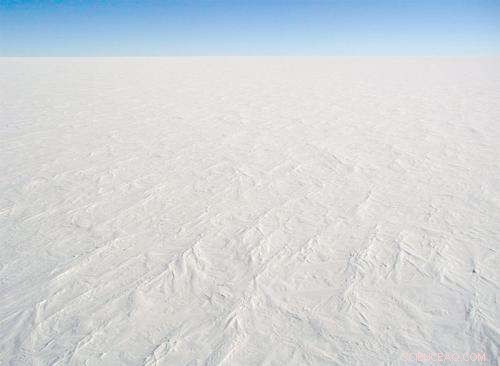
The Antarctic ice sheet. Credit: Stephen Hudson / Wikipedia
(Phys.org)—An international team of researchers has examined ice cores taken from an island in northern Canada in the 1980s and found that air temperatures during the Holocene were higher than today. Further, there have been unprecedented air temperature changes in the area over the past half-century. In their paper published in Proceedings of the National Academy of Sciences, the group describes their study of the cores and why they believe it may help better understand what might happen to our planet due to global warming.
Prior evidence has shown that global warming is happening in different degrees in different parts of the world, and that the biggest changes are occurring in the Arctic. As the planet warms, scientists look for examples from the past to predict what might happen in the future. In this new effort, the researchers report that temperatures at the end of the last ice age (8,000 to 11,000 years ago) were slightly warmer than they are today, which suggests that other studies might show the impact that such high temperatures had on the rest of the planet.
The ice cores were taken from the Agassiz ice cap on Ellesmere Island several decades ago, but were not thoroughly examined due to budget constraints. They now reside at a site on the University of Alberta campus, which allowed the team access for study. The cores came from depths as much as a kilometer, offering a look into the distant past. The researchers measured ice that had melted and subsequently refroze and oxygen isotopes to learn more about air conditions during the time of their formation. The team reports that they found matching results from the two measuring methods, which strengthens their findings. They also report that overall, their findings offer more evidence of global warming which, they suggest, is most certainly due to human factors—natural factors, such as those that led to a warmer world during the Holocene (variations in the Earth's orbit and tilt) occur at a much slower rate.
The researchers suggest more research be done to look for changes wrought by the warmer conditions during the Holocene, both in the Arctic and other parts of the world, to predict what changes might be ahead.
© 2017 Phys.org