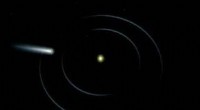
Kepler-62f is about the same size as Earth, with a radius of about 1.4 Earth radii. Its mass is unknown, but it is estimated to be between 1.1 and 2.7 Earth masses. The planet orbits its star every 267.3 days and receives about the same amount of sunlight as Earth does from the Sun. This means that Kepler-62f could have a surface temperature similar to Earth's, and could potentially support liquid water on its surface.
The discovery of Kepler-62f is significant because it is one of the first Earth-sized exoplanets to be discovered in the habitable zone of a Sun-like star. This suggests that there may be many more potentially habitable planets out there in the galaxy.
One of the most interesting things about Kepler-62f is that it is covered in water. This is based on the fact that the planet has a relatively large radius and a low density, which suggests that it is made up mostly of water. This makes Kepler-62f a very interesting target for future study, as it could provide insights into the formation and evolution of Earth and other water-rich planets.
Here are some additional facts about Kepler-62f:
- It is the outermost planet in its star system, with five other planets closer to the star.
- It is the only planet in its star system that is located in the habitable zone.
- The planet's surface temperature is estimated to be between 0 and 50 degrees Celsius (32 and 122 degrees Fahrenheit).
- The planet's atmosphere is likely to be composed mostly of water vapor, carbon dioxide, and nitrogen.
- The planet could potentially have a surface covered in oceans, with some landmasses.
- The planet could potentially support life, although this is still unknown.
Kepler-62f is a fascinating and potentially habitable exoplanet that is sure to be the subject of much future research.