We like to name things after ourselves. After all, if we discovered it, why not? Halley's comet. Charcot-Marie-Tooth disease. The Doppler effect. These are all examples of eponymous discoveries (and three we'll be talking about later), which means each is a discovery named after its discoverer. You come across this type of naming frequently, often in medical discoveries (diseases and organs named after the first to describe what they have found), in mathematics, in physics and in other sciences.
There's a funny thing about how discoveries are named, though. Sometimes, discoveries are named in honor of a person who wasn't the actual discoverer. And there's even a law about that. Stigler's Law of eponymy states that no scientific discovery is named after its actual discoverer (dig a little deeper into the law and you'll also find the law suggests that if a discovery is named for its discoverer, that's not likely to happen during their lifetime) [source: Stigler]. It's part tongue-in-cheek and part actual observation, but maybe Stigler's onto something -- we're certainly not shy about naming discoveries after people, whether they had anything to do with said finding or not. Take, for example, a marshland bunny native to the American southeast named for Hugh Hefner. And then there's a rare horse fly with an ample gold derriere named for Beyoncé. Neither Hefner nor Beyoncé logged any field work.
Our list of 10 includes some eponymous discoveries named for actual discoverers, and some given honorary names. Think you can guess which ones are which? Let's kick this list off with a discovery named for its actual discoverer: the Heisenberg uncertainty principle.
ContentsIf there's one thing we humans do well, it's meddle. Our meddlesome ways are no superficial pastime -- our influence can be found as deep as the atoms and molecules around us, at the tiniest level of quantum mechanics.
German theoretical physicist Werner Heisenberg, on the heels of his formulation of matrix mechanics (his early breakthrough work in the development of quantum mechanics), proposed this very thing in 1927; it is impossible to determine a particle's exact location and exact momentum because we affect that particle's momentum. This is the Heisenberg uncertainty principle in quantum theory. And although it's unintentional and unpredictable, it's unavoidable (at least as far as we know today).
 The Mandelbrot set is the most famous of the fractals, and is often used to create computer-generated fractal art.
Thinkstock/Hemera
The Mandelbrot set is the most famous of the fractals, and is often used to create computer-generated fractal art.
Thinkstock/Hemera
There are two things you should know about Benoit B. Mandelbrot. One: Mandelbrot is the father of fractal geometry. And two: The "B" as his middle initial doesn't actually stand for anything, and was added by Mandelbrot himself.
Fractal geometry is based on Mandelbrot's idea that the world around us is not smooth, but that there are uneven and irregular shapes with rough, fragmented edges, and no matter how much you magnify those shapes, they continue to look uneven, irregular, rough and fragmented -- but a smaller version of the same pattern is repeated time and again each time you zoom a little closer. Fractal mathematics is the tool used to tease out those patterns.
Mandelbrot coined the word "fractal" to describe irregular and fragmented mathematical shapes similar to those found in nature (such as a cloud or a coastline). The Mandelbrot set (and this is true of every fractal) is actually a mathematical set (a collection of numbers). But if fractals are a collection of numbers, how is it that most of us are familiar with fractals as images? Mandelbrot created the first images of these mathematical sets by plotting thousands of points on a complex number plane with the help of a computer in 1978 while he worked as a mathematician at the IBM Thomas J. Watson Research Center, and these images were officially named after him in the 1980s.
 Edmund Halley never got to see the comet named after him.
Digital Vision/Thinkstock
Edmund Halley never got to see the comet named after him.
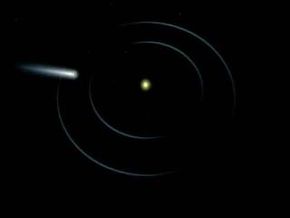
Digital Vision/ThinkstockThere's a long-standing deal: Discover a comet, and it'll be named after you. Halley's comet is an example of this, named for 17th-century English astronomer Edmund Halley, who discovered its periodic orbit while studying historical comet observations occurring between the 14th and 17th centuries.
Halley noticed that three comets -- one observed in 1531, a second observed in 1607 and a third observed in 1682 -- had strikingly similar descriptions. Based on those descriptions, Halley hypothesized it was the same comet, the first with a periodic orbit to be discovered -- and that it would make its next appearance in 1758. Halley was correct, but died before he could see his comet return.
It's difficult to avoid the Epstein-Barr virus (EBV). It infects children, adolescents and adults -- 95 percent of American adults between the ages of 35 and 40 have been infected sometime during their lives, so chances are good you and the virus are acquainted [sources: National Center for Infectious Diseases, Andersson]. Once you're infected with EBV, it's with you for life.
EBV is part of the herpes virus family (HHV-4), a family whose members include chickenpox, shingles, and oral and genital herpes, among others. In some people, the virus causes infectious mononucleosis (mono), with fever, fatigue, sore throat and swollen lymph glands as its primary symptoms. Those symptoms last about one to two months, although you may be infected and never have any symptoms.
EBV wasn't always known to cause mono (and, rarely, also Burkitt's lymphoma and some nose and throat cancers). Mono was first described in the Bulletin of the Johns Hopkins Hospital in 1920 (although the illness was recognized earlier than that), but it wasn't until 1964 when mono was linked to HHV-4 by two scientists, Michael Anthony Epstein and Yvonne Barr, and the virus got its name.
Can you guess what Gabriele Falloppio discovered?Fallopian tubes, part of a woman's reproductive system, are named after the man who discovered them, Gabriele Falloppio, an Italian physician studying anatomy during the mid-16th century. Despite his discovery, it's thought that Falloppio never understood how the female reproductive system worked, and that it was 17th century Dutch physician and anatomist Reinier De Graaf who first discovered what use the Fallopian tubes have.
Earth wears a belt. Actually, two belts. Surrounding Earth are two toroidal (doughnut shaped) radiation belts, one considered the outer and the other the inner belt. They were discovered in 1958 by astrophysicist James Van Allen, whose team at the University of Iowa was responsible for the instrumentation aboard the first U.S. science satellite, Explorer 1. Van Allen used data collected by Explorer 1 during its orbit of Earth, specifically a lower-than-expected cosmic ray count, to suggest the existence of a radiation belt around the planet
He was right. The Van Allen radiation belts are created by high-energy, electrically-charged particles (almost all protons and electrons) that originate from the sun (this is also known as cosmic radiation) and become trapped in the Earth's magnetic field. The belts are considered to be some of the most dangerous regions of space as we know it.
 A Verreaux's sifaka perched in a tree
©iStockphoto/Thinkstock
A Verreaux's sifaka perched in a tree
©iStockphoto/ThinkstockJules Verreaux and his brother Edward were 19th-century naturalists, and as it turns out, also quite worldly taxidermists. They traveled the world (spending a lot of time in South Africa) looking for specimens to provide to private collectors as well as museums. During those travels, the Verreaux brothers stuffed and sold animals (as well as a controversial and unfortunate human specimen, a man from Botswana), but they also played a role in introducing new species to those back home in France, from a whale shark off the coast of the Cape of Good Hope to lemurs in Madagascar.
The Verreaux's sifaka is one of those species. The sifaka are lemurs (primates) that look like small monkeys. They live in the treetops on the island of Madagascar (and when they're not in the treetops they hop on their hind legs, using their forearms to keep themselves balanced). Because of deforestation and related issues, the sifaka today are currently endangered.
Darth Vader Beetle?There's a slime-mold beetle named Agathidium vaderi in honor of Darth Vader. Don't be quick to judge the slime-mold beetle's villainous nature, though -- it got its name strictly from the similarities between its head and Vader's helmet.
Avogadro's number, also known as NA, is 6.0221415 × 10²³, and is the constant thing that links the world around us that we can see with the world around us that is submicroscopic -- the world we can't see. Avogadro's number represents the number of atoms in a mole, a standard unit of measurement used in chemistry.
But Avogadro didn't discover this number. The number was given his name as an honor because of an important discovery he made in the field of chemistry.
Lorenzo Romano Amedeo Carlo Avogadro was an Italian scientist living in the late 18th- to mid-19th centuries, during a time when scientists were discovering the basic ways atoms and molecules work. Avogadro's contribution was his theory -- Avogadro's Law -- that two gases that are equal volume, at the same temperature and at the same pressure, must each contain the same number of molecules regardless of the chemical nature of the gases.
Charcot-Marie-Tooth disease (CMT) is a hereditary neurological disorder that affects the motor and sensory nerves -- the function of the arms and legs. It affects an estimated 1 out of every 2,500 Americans, making it one of the more common inherited neurological disorders [source: NINDS].
CMT causes muscle weakness, muscle atrophy, balance problems, an awkward gait, difficulty running, numbness and foot deformities. Despite what its name might suggest, it's not something you'd call your dentist about. And what about that name? The disorder bears the name of the three physicians who first described it in 1886, Jean-Martin Charcot, Pierrre Marie and Howard Henry Tooth.
Sometimes It Pays to Be First AlphabeticallyWhen it comes to publishing your scientific discoveries, sometimes it pays to be first alphabetically. Physicians Burrill Bernard Crohn, Leon Ginzburg, and Gordeon Oppenheimer together published a paper on their findings of a new type of intestinal inflammation, but it was Crohn who the condition was named after: Crohn's disease.
Imagine this: You're standing in a crosswalk waiting to cross the street. While you wait, you see a firetruck turn onto the street, lights flashing and sirens blaring. You notice that as the truck gets closer to you, its siren sounds louder and higher until the truck passes you and the siren's sound becomes quieter and lower as the truck disappears down the road.
The pitch of the siren's sound changes based on where it is in relation to you and how fast it's moving -- all while the source of the sound (the siren) and the velocity of the sound waves remain unchanged. As the siren gets closer to you, the pitch of its sound increases (higher and louder) because the closer the siren is to you the shorter the sound waves between you and it. The same is true in reverse: As the siren passes and gains distance from you, the pitch of its sound decreases (quieter and lower) as the sound waves between you and it become longer.
This phenomenon is named for Christian Johann Doppler, the 19th-century physicist who made the discovery.
During his lifetime, in the late 18th and early 19th centuries, Italian physicist Alessandro Volta was behind significant breakthroughs in electricity, electrical phenomena and electrical power at a time when scientists were studying and theorizing about animal electricity. Volta moved the study of electricity from the electric potential of animals to the electric potential of metals.
Volta was not only proficient in his field but prolific. He gave us volts, voltage -- think of all the terms we use that are based on Volta's name when we talk about electricity. Volts are the unit of measure used to describe electric potential and electromotive force. Voltage is electric potential and electromotive force (think of it as the difference in electric potential between two electrical charges). Voltaic electricity is electricity produced by a chemical action. And don't forget the voltaic pile, for which Volta used the idea of voltaic electricity to create the world's first battery.
WattsJames Watt is known as the inventor of the modern steam engine, the Watt steam engine, but we really should remember him as the man who gave us some of the most important ideas and terms we have about power. He was a mechanical engineer who coined the term "horsepower" as a way to describe how powerful his steam engines were compared to how much weight a horse could move, and how quickly. And the watt? We'll give you one guess as to who that's named after.
I was excited when I saw this assignment, and got lost in my research for far longer than I probably should have. There were three distinct moments during my research process that I couldn't help but chatter on about with friends, as if I'd happened upon a big discovery of my own. First, did you know if you discover a comet you can pretty much count on it be named in your honor? Second, when publishing your scientific discoveries pay close attention to who is listed first as author -- being first in the article's byline could mean a disease or discovery gets named after you. And finally, there were the taxidermist-naturalist Verreaux brothers (whom I'd never previously heard of) who sold exotic animals and, perhaps, sometimes humans(!) to private collectors and museums (and happened to discover species new-to-France).