The Arctic contains several million lakes that store vast amounts of organic material from plants, animals, and microorganisms that have accumulated there during the past 15,000 years. If this material decays under oxygen-depleted conditions, such as in lake sediments, methane is produced. Rising temperatures due to global warming could result in increased decomposition of this material, leading to more methane release and contributing further to global warming.
"To better understand the mechanisms and timescales of this feedback, it is important to study past warm periods such as the last interglacial period, about 125,000 years ago. Temperatures were then about 1-3 °C higher than during pre-industrial times, when global warming started. The extent of methane release during this period is, however, still uncertain," says Dr. André Bornemann, lead author of the study and researcher at the GFZ.
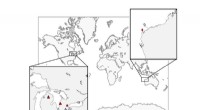
To address this uncertainty, the research team used plant leaf waxes trapped in a lake sediment core from Lake El'gygytgyn in northeastern Siberia as an indicator for past methane release. Plant leaf waxes are known to carry a chemical fingerprint of the atmospheric composition they were once exposed to.
"As the lakes are ice-covered for a large part of the year, the wax that is preserved in lake sediment cores originates from plants growing in the surroundings in summer, when the lake is open. We are specifically looking at long-chain n-alkyl diols, a certain type of plant leaf wax that carries the strongest imprint of atmospheric methane concentrations," explains Bornemann.
The researchers analyzed the leaf wax concentrations and their carbon isotope composition in 22 samples along the core spanning the period between 170,000 and 95,000 years ago. "The carbon isotope composition of the plant waxes revealed a clear relationship with local methane emissions during the last interglacial period," says co-author Dr. Florian F. Krause-Kyora, now a researcher at the Paul Scherrer Institute in Switzerland.
The research team found that the plant leaf wax isotopic record correlates well with independent estimates of methane concentrations in the atmosphere as well as with estimates of methane release from wetlands in the Arctic region. This indicates that the leaf wax record from El'gygytgyn Lake is a suitable tool for studying past methane release.
The leaf wax record shows that methane release from Arctic lakes was much higher during the last interglacial period compared to the time before and after. The methane release from the lakes even reached similar levels as the global methane emissions from wetlands today, which amounts to about 100 million tonnes of methane released annually.
"This means that if the world warms by another 1-2 °C, the methane release from Arctic lakes could also double compared to today, and become almost as high as the global wetland emissions," says Bornemann. Given that the current atmospheric levels of methane are the highest in over 800,000 years, such an increase from Arctic lakes could have the potential to further increase the rate of human-induced climate change.