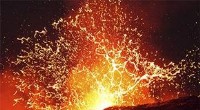
* Internal Processes: These processes originate from forces within the Earth. They are driven by the Earth's internal heat and the movement of tectonic plates.
* Diastrophism: This refers to the large-scale deformation of the Earth's crust, resulting in the formation of mountains, valleys, plateaus, and other landforms. It includes processes like folding, faulting, and uplift.
Examples of Diastrophism:
* Mountain Building: The collision of tectonic plates creates immense pressure, folding and uplifting the crust to form mountain ranges.
* Faulting: The Earth's crust can break along fractures called faults. These fractures can cause sudden movements, leading to earthquakes and the creation of valleys or cliffs.
* Uplift: Large sections of the Earth's crust can be pushed upward, forming plateaus or creating new land areas.
In contrast to internal processes, external geomorphic processes are driven by forces outside the Earth, like:
* Weathering: The breakdown of rocks and minerals by physical and chemical processes.
* Erosion: The movement of weathered material by wind, water, or ice.
* Deposition: The accumulation of eroded material in new locations.
Therefore, diastrophism, being driven by tectonic forces within the Earth, is classified as an internal geomorphic process.