Here's a breakdown of the features of Earth's three main layers:
1. Crust:
* Composition: Primarily composed of lighter elements like silicon, oxygen, aluminum, iron, calcium, sodium, potassium, and magnesium.
* Thickness: Varies greatly, from 3-5 km thick under the oceans (oceanic crust) to 30-70 km thick under continents (continental crust).
* Density: Less dense than the mantle.
* Temperature: Relatively cool compared to the other layers, ranging from around 20°C at the surface to about 1000°C at the boundary with the mantle.
* Features:
* Oceanic Crust: Thinner, denser, and younger than continental crust. It's constantly being formed at mid-ocean ridges and subducted (pulled) back into the mantle at trenches.
* Continental Crust: Thicker, less dense, and older than oceanic crust. It's made up of various rock types, including granite, basalt, and sedimentary rocks.
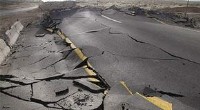
* Key Characteristic: The crust is Earth's outermost, solid layer and is relatively brittle.
2. Mantle:
* Composition: Predominantly composed of silicate minerals like olivine and pyroxene, along with some iron and magnesium.
* Thickness: About 2900 km thick, making up 84% of Earth's volume.
* Density: More dense than the crust, but less dense than the core.
* Temperature: Incredibly hot, ranging from about 1000°C at the top to over 4000°C near the core.
* Features:
* Upper Mantle: Includes the rigid lithosphere (crust and uppermost mantle) and the asthenosphere, a partially molten zone.
* Lower Mantle: A more rigid and solid layer, despite being extremely hot.
* Key Characteristic: The mantle is a solid but behaves like a very viscous fluid over long periods, enabling plate tectonics.
3. Core:
* Composition: Primarily composed of iron with a significant amount of nickel.
* Thickness: About 2200 km thick, divided into two parts:
* Outer Core: About 2200 km thick, liquid and composed of iron and nickel. This layer generates Earth's magnetic field.
* Inner Core: About 1220 km thick, solid and composed of iron and nickel. It is incredibly dense and hot, due to intense pressure.
* Density: The densest layer of Earth.
* Temperature: Extremely hot, estimated to be over 5000°C.
* Key Characteristic: The core's unique properties are responsible for Earth's magnetic field and its role in the planet's rotation.
Important Note: The boundaries between these layers are not sharp, but rather transition zones where the composition and physical properties gradually change.