1. Subduction:
* The denser plate, usually the older and colder one, is forced beneath the less dense plate. This process is called subduction.
* The descending plate melts as it moves deeper into the Earth's mantle due to the increasing heat and pressure.
2. Volcanic Arcs:
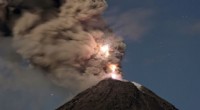
* The molten material from the subducting plate rises to the surface and erupts, forming a chain of volcanoes called a volcanic arc.
* These volcanoes often occur on the overriding plate, parallel to the trench. Examples include the Aleutian Islands, the Mariana Islands, and the Andes Mountains.
3. Trenches:
* The point where the two plates meet forms a deep depression in the ocean floor called a trench.
* Trenches are the deepest parts of the ocean, often exceeding 10,000 meters (33,000 feet) in depth. The Mariana Trench, home to the deepest known point on Earth, is a prime example.
4. Earthquakes:
* The process of subduction is highly energetic, resulting in frequent and powerful earthquakes.
* These earthquakes can be devastating, as evidenced by the 2011 Tohoku earthquake and tsunami in Japan.
5. Accretionary Prisms:
* Sediments and rock fragments scraped off the descending plate accumulate at the edge of the overriding plate, forming a wedge-shaped mass called an accretionary prism.
* This accumulation contributes to the growth of continental margins.
6. Back-Arc Basins:
* In some cases, the tension caused by the subducting plate can lead to the formation of a back-arc basin behind the volcanic arc.
* These basins are often associated with seafloor spreading and the formation of new oceanic crust.
7. Island Arcs:
* When volcanic arcs emerge above sea level, they form island arcs, like the Japanese archipelago or the Philippines.
In summary, the convergence of two oceanic plates is a complex and dynamic process that creates some of the most dramatic and geologically active regions on Earth, shaping our planet's surface and influencing its climate and ecosystems.