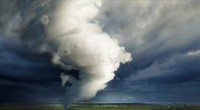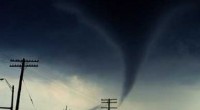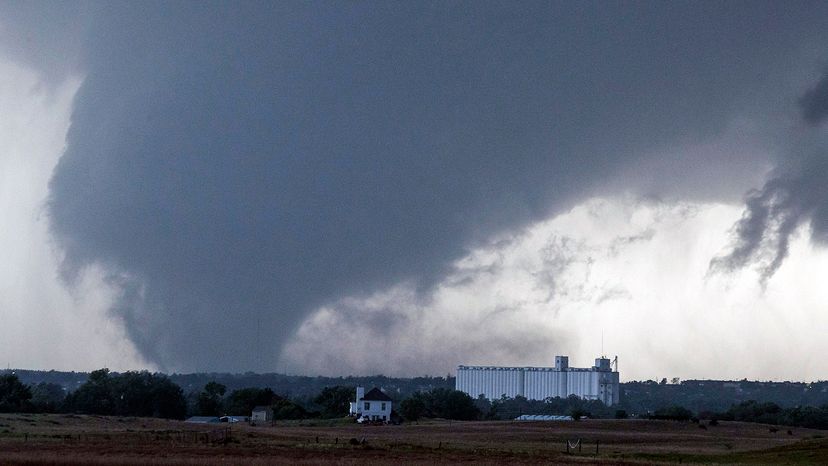
You're sitting in your favorite recliner reading a book when the sky suddenly turns dark. You've seen severe storms, but this one is different. The floors shake beneath your feet, the wind beats at your front door and then, through your picture window, you see it in the distance — a large, violent, spinning creature heading for your house.
Being in a tornado could be one of the most harrowing experiences you can go through in your lifetime. These massive twisting storms can reach wind speeds of 318 miles per hour (512 kilometers per hour) and measure miles across. With speeds like that, they can scar the Earth and decimate everything in their path. The United States alone experiences more than 1,000 tornadoes a year, and the storms have been reported on every continent except Antarctica. Preparedness is the key to survival, so here are five tips to guide you if and when the time comes.
Contents Having a plan in place before a tornado hits can increase your family's chance of surviving. NOAA
You and your family can benefit from having a disaster plan in place, especially if you live in an area of the country where tornadoes frequently occur, like Tornado Alley. This is a nickname given to the Southern Plains of the central United States because it experiences a high frequency of tornadoes every year.
The first thing you need to determine is where everyone should take cover in case of a tornado. A basement or underground shelter is the safest location, followed by an interior room or bathroom. Bathrooms are a good choice because their plumbing is anchored into the ground, plus they have extra framing. An interior hallway is the next best place, as long as you have something heavy to hide under, because falling debris will probably get to you before the actual tornado.
If you live in a mobile home, get out immediately and head to an underground community shelter. If there is no such facility available, select a low-lying ditch nearby. You should designate an out-of-town family member as a contact person in case your family gets separated, and make sure everyone knows his or her phone number by heart.
The American Red Cross suggests you create an emergency supply kit, as well, to keep on hand in case of a disaster situation:
 NOAA weather radios provide constant monitoring of storms, 24 hours a day. NOAA
 Time is of the essence during a tornado. If you're sleeping or otherwise occupied as a storm begins to build, you may have no idea of the danger you and your family are in.
NOAA (National Oceanic Atmospheric Association) Weather Radios send out bulletins and alerts 24 hours a day. The radios can be programmed to emit only information pertaining to your community. In short, you may hear nothing out of the radio for months, but you'll be alerted to find shelter when it matters most. The Federal Emergency Management Agency recommends having a weather radio as part of your disaster kit. Weather radios are battery-operated, so if you lose electricity, you'll still receive the necessary information.
 Swirling storm clouds are good indicators that a tornado may be imminent. NOAA
Radios and weather reports are helpful, but tornadoes are tricky creatures and can appear out of nowhere. Keep an eye on the sky. The first clue a tornado is possible is a sickly green color. Clouds are another good indicator. If they're moving quickly, you should keep an eye on them, and if one starts to rotate in the shape of a funnel, you should take cover immediately. If a tornado watch or warning has been issued, hail is cause for concern. If you see flying debris or hear the sound of a train, head for your shelter immediately.
The greatest danger during a tornado is being injured by flying debris. You probably remember the tornado drills of your elementary school days, during which you and your classmates calmly filed into the hall, got down on your knees, tucked your head and covered the back of your neck. The rules are still the same. You can stow blankets, old mattresses and couch cushions in your shelter to cover yourself with in the event of a tornado. If your bathroom is your shelter, grab some couch cushions, hop in the tub and cover yourself until the storm passes.
 If you're driving and encounter a tornado, get out of your car and seek shelter in a ditch or the bottom of the hill. Brent R. Koops/NOAA
The rules for tornado safety change if you encounter one while you're in your vehicle. It's important to know ahead of time what you should do because you're not going to have a lot of time to think about it if it happens. If you spot a tornado while driving, you need to stop the car and get out. It may sound counter-intuitive, but your car is no match for a tornado. Your car can't outrun it, and there's no safe place to hide inside it. Look for the closest low area of ground — a ditch or the bottom of the hill. Lie flat, cover your head and wait for the tornado to pass.
Now That's HelpfulSeeking shelter from a tornado under a highway underpass is not safe. As a tornado approaches an underpass, it creates a wind tunnel effect, so the wind in the underpass will actually be stronger than the wind above it or on the ground. So if you're driving and have to seek shelter from a tornado, don't do it in a highway underpass.
Originally Published: Aug 10, 2010
Sources