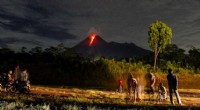
* Island arcs: These are chains of volcanic islands that form along the edge of the overriding plate. The denser plate subducts beneath the less dense plate, and as it descends, it melts. This molten rock rises to the surface, creating volcanoes. The volcanic islands can eventually grow large enough to become part of a continent.
* Trench: This is a deep, narrow depression in the ocean floor that forms at the point where the two plates meet. The trench is the deepest part of the ocean and can extend for hundreds of kilometers.
* Accretionary wedge: This is a pile of sediment and rock that has been scraped off the subducting plate and piled up against the overriding plate. The accretionary wedge can be quite large, and it often forms a mountain range.
* Back-arc basins: These are areas of thinned crust that form behind the volcanic arc. They are often characterized by shallow seas and active volcanism.
Here's a simplified explanation:
1. Subduction: One plate dives beneath the other.
2. Melting: The subducting plate melts due to heat and pressure.
3. Magma rises: The molten rock rises to the surface.
4. Volcanic activity: The magma erupts, forming volcanoes and islands.
5. Trench formation: The collision creates a deep trench where the plates meet.
6. Accretion: Scraped-off material builds up, creating an accretionary wedge.
7. Back-arc basins: Stretching behind the volcanic arc creates basins.
Examples of these features include:
* The Mariana Trench: The deepest point in the ocean, formed by the collision of the Pacific and Philippine plates.
* The Aleutian Islands: A volcanic island arc formed by the collision of the Pacific and North American plates.
* The Andes Mountains: A mountain range formed by the collision of the Nazca and South American plates.
These collisions are responsible for some of the most dramatic and geologically active features on Earth.