1. Tidal Action and Erosion:
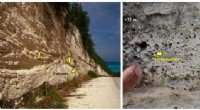
* The Bay of Fundy experiences the highest tides in the world, with a difference of up to 40 feet between high and low tide. This extreme tidal range creates powerful currents that erode the sandstone cliffs along the coast.
* The constant pounding of waves and the scouring action of the tides carve out the unique shapes of the Hopewell Rocks.
2. Differential Weathering:
* The sandstone that makes up the cliffs is not uniform. Some layers are harder and more resistant to erosion than others.
* Over time, the softer layers are eroded away faster, leaving behind the harder layers as pillars and arches.
3. Freeze-Thaw Cycles:
* In winter, water seeps into cracks and crevices in the rocks. When temperatures drop below freezing, the water expands and creates pressure.
* This freeze-thaw cycle widens the cracks and helps to break down the rock, contributing to the formation of the pillars and arches.
4. Glacial Activity:
* During the last glacial period, glaciers covered the area. As the glaciers retreated, they left behind a landscape of eroded rocks and sediments.
* This glacial activity played a role in shaping the landscape and providing the raw materials for the sandstone cliffs.
5. Human Influence:
* While the primary forces behind the Hopewell Rocks are natural, some human activities, like coastal development and pollution, can impact the rate of erosion and the overall shape of the rocks.
In summary, the Hopewell Rocks are a result of the combined forces of tidal erosion, differential weathering, freeze-thaw cycles, and glacial activity over millions of years. This unique combination of geological forces has created one of the most spectacular natural wonders in the world.