1. Plate Tectonics:
* The Earth's outer layer, the lithosphere, is broken into massive pieces called tectonic plates. These plates constantly move, driven by heat from the Earth's core.
* There are three main types of plate boundaries:
* Convergent boundaries: Where plates collide.
* Divergent boundaries: Where plates pull apart.
* Transform boundaries: Where plates slide past each other.
2. Stress and Strain:
* As plates move, they exert stress on each other. This stress causes strain in the rocks along the plate boundaries.
* Think of it like bending a stick – it will bend until it reaches its breaking point.
3. Fault Formation:
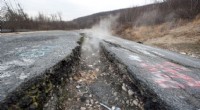
* When the stress overcomes the strength of the rocks, they fracture along faults. These faults are zones of weakness where rocks have broken and moved past each other.
* There are different types of faults, depending on the direction of the movement:
* Normal faults: Occur at divergent boundaries where the hanging wall (the block above the fault) moves down relative to the footwall (the block below the fault).
* Reverse faults: Occur at convergent boundaries where the hanging wall moves up relative to the footwall.
* Strike-slip faults: Occur at transform boundaries where plates slide horizontally past each other.
4. Earthquake Occurrence:
* When rocks along a fault suddenly slip past each other, releasing the stored energy, an earthquake occurs. This movement causes seismic waves that travel through the Earth, creating the shaking and ground motion we feel.
* The epicenter of an earthquake is the point on the Earth's surface directly above the focus, where the rupture begins.
5. Magnitude and Intensity:
* The magnitude of an earthquake measures the energy released at the source. It is determined by the amount of ground movement and the size of the fault rupture.
* The intensity of an earthquake describes the effects of the earthquake on the surface. It is measured by the amount of damage caused and the level of shaking felt by people.
In summary, tectonic earthquakes are caused by the movement of Earth's tectonic plates, which creates stress and strain in the rocks along fault lines. When the stress overcomes the strength of the rocks, they rupture, releasing stored energy in the form of seismic waves that we experience as earthquakes.