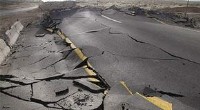
* Faulting: The Earth's crust is constantly shifting and moving due to tectonic forces. These forces can cause the crust to break along lines of weakness called faults.
* Displacement: When a fault forms, the rocks on either side of the fault can move in different directions, either up, down, horizontally, or a combination of these movements.
* Older Rocks on Top: If a fault causes a block of rock to move upwards relative to another block, older rocks can end up sitting on top of younger rocks. This is because older rocks are typically found at deeper levels of the Earth's crust.
Here's an example:
Imagine two blocks of rock, Block A and Block B, separated by a fault. Block A is older than Block B. If Block A is pushed upwards along the fault, it will appear on top of Block B, even though it is older.
Other Scenarios:
* Folding: While faulting is the most common reason, folding of rock layers can also create situations where older rocks are found on top of younger ones. This occurs when layers are bent or folded, often during mountain-building processes.
* Erosion: In some cases, erosion can remove younger layers of rock, revealing older layers beneath them. This process can create a "window" where older rocks are exposed at the surface.
Important Note: Identifying the age of rocks and understanding how they've been moved or exposed is a complex process that geologists analyze using various techniques, including:
* Stratigraphy: Studying the layering of rocks and their fossils.
* Radiometric Dating: Measuring the decay of radioactive isotopes in rocks to determine their absolute age.
* Structural Geology: Analyzing the deformation and movements of rocks within the Earth's crust.