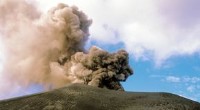
For the first 1.5 billion years of Earth's history, the planet's crust was in a constant state of flux. The Earth was constantly being bombarded by asteroids and comets, and the resulting heat and pressure caused the crust to melt and reform repeatedly. This made it impossible for life to gain a foothold on the planet.
However, around 2.5 billion years ago, something changed. The Earth's crust began to cool and solidify, and it became much more stable. This allowed for the development of the first permanent landmasses, which in turn provided a habitat for the first life forms.
The formation of a stronger crust was a critical step in the evolution of life on Earth. Without it, life would not have been able to survive the harsh conditions of the early Earth. The development of a stable crust allowed for the development of the first ecosystems, which eventually led to the evolution of complex life forms, including humans.
The Earth's crust is made up of two types of rocks: igneous rocks and sedimentary rocks. Igneous rocks are formed when magma cools and crystallizes. Sedimentary rocks are formed when sediments, such as sand, mud, and gravel, are deposited and compacted over time.
The Earth's crust began to form when the planet's surface began to cool and solidify. As the surface cooled, it formed a thin layer of igneous rock. This layer was constantly being bombarded by asteroids and comets, which caused it to melt and reform repeatedly.
However, over time, the Earth's crust became thicker and stronger. This was due to the process of plate tectonics. Plate tectonics is the movement of the Earth's tectonic plates, which are large pieces of the Earth's crust. As the tectonic plates move, they collide with each other, which causes them to fold, buckle, and melt. This process creates new igneous rock, which adds to the thickness of the crust.
The formation of a thicker and stronger crust was a critical step in the evolution of life on Earth. Without it, life would not have been able to survive the harsh conditions of the early Earth. The development of a stable crust allowed for the development of the first ecosystems, which eventually led to the evolution of complex life forms, including humans.
The formation of a stronger crust had a profound impact on the evolution of life on Earth. It allowed for the development of the first permanent landmasses, which provided a habitat for the first life forms. It also led to the development of the first ecosystems, which eventually led to the evolution of complex life forms, including humans.
The crust also plays an important role in regulating the Earth's climate. The crust absorbs heat from the sun, which helps to keep the Earth's surface warm. The crust also releases heat back into the atmosphere, which helps to prevent the Earth from becoming too cold.
The crust also plays an important role in the cycling of nutrients. The crust contains a variety of nutrients that are essential for life. These nutrients are released into the soil when the crust is weathered. The nutrients are then taken up by plants, which are eaten by animals. This process helps to keep the nutrients cycling through the ecosystem.
The crust is a vital part of the Earth's ecosystem. It provides a habitat for life, regulates the Earth's climate, and cycles nutrients. Without the crust, life on Earth would not be possible.