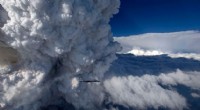
Great Sitkin Volcano is one of the most active volcanoes in the Aleutian Islands, and has been erupting continuously since 1974. The eruption is unusual in that it has lasted for so long, and has produced a wide variety of lava types.
The researchers used a variety of techniques to study the volcano, including field observations, petrology, and geochemistry. They found that the volcano is located at a triple junction of tectonic plates, where the Pacific Plate, the North American Plate, and the Bering Plate meet. This location allows for a variety of magma sources, which can mix to produce the different lava types that have been erupted.
The researchers also found that the volcano's magma is relatively high in silica, which makes it more viscous and slower-flowing. This slow flow rate allows the magma to cool and crystallize before it reaches the surface, which can lead to the formation of explosive eruptions.
The combination of these factors has created the conditions for the long-lived eruption of Great Sitkin Volcano. The volcano is likely to continue to erupt for many years to come, and could pose a significant hazard to nearby communities.
The findings of this study have important implications for understanding the behavior of volcanoes in the Aleutian Islands and other subduction zones. They also provide insights into the processes that drive long-lived eruptions, which can help to improve our ability to predict and mitigate volcanic hazards.