Here's the breakdown:
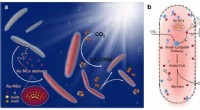
* Light energy is captured by chlorophyll within chloroplasts.
* This light energy is used to split water molecules, releasing electrons and protons (H+ ions).
* The electrons are passed along an electron transport chain, releasing energy that is used to pump protons across a membrane. This creates a proton gradient.
* The proton gradient drives the production of ATP (adenosine triphosphate), which is a high-energy molecule used by the cell for various functions.
* The electrons also help convert carbon dioxide (CO2) into sugar (glucose), another high-energy molecule.
So, while photosynthesis doesn't use high-energy molecules, it produces two key high-energy molecules:
1. ATP: A universal energy currency used for many cellular processes.
2. Glucose: A sugar that serves as the primary energy source for most organisms.