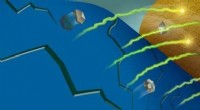
Imagine observing a single water molecule up close. Its shape resembles a bent “V,” with the oxygen atom at the apex and the two hydrogen atoms at the 104.5‑degree angles, much like a tiny, asymmetric magnet.
The angular geometry gives water a permanent electric dipole moment: the oxygen side carries a partial negative charge, while the hydrogen side carries a partial positive charge. This polarity is the foundation of hydrogen bonding, the subtle yet powerful attraction between neighboring molecules.
Unlike covalent bonds that lock atoms together, hydrogen bonds are comparatively weak but persistent. They enable water to exhibit several anomalous behaviors that are critical for life.
Water molecules pull on one another, creating surface tension that lets insects walk on water and allows plant roots to draw liquid upward through capillaries.
Breaking hydrogen bonds requires significant energy, raising water’s boiling point to 100 °C—much higher than for similar molecules like H₂Se or H₂S, which boil below zero. Without this, Earth would have no stable liquid water.
When water freezes, hydrogen bonds form an open lattice, expanding the structure and reducing density. Ice is therefore less dense than liquid water, which keeps bodies of water from freezing solid and sustains aquatic life in winter.
Water’s polarity dissolves a wide range of substances, from electrolytes to organic compounds, making it indispensable for biochemical reactions and nutrient transport in living organisms.
Microwave ovens exploit water’s dipole moment: high‑frequency radiation aligns and agitates the dipoles, generating heat that cooks food efficiently. This is a direct application of the same magnetic‑like behavior that drives water’s natural properties.
These phenomena underscore why water is often described as the “universal solvent” and the “lifeblood” of ecosystems.