Understanding the equilibrium between hydronium (H₃O⁺) and hydroxide (OH⁻) ions is essential for accurate pH calculations in aqueous chemistry.
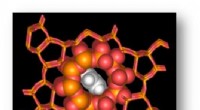
Water (H₂O) is a polar solvent that can transiently bind a proton (H⁺), forming the hydronium ion. In acidic solutions, [H₃O⁺] dominates over [OH⁻], and their product is fixed by the water dissociation constant.
At 25 °C the dissociation constant of water is:
Kw = 1.0 × 10⁻¹⁴ = [H₃O⁺][OH⁻]
This relationship allows you to compute one ion’s concentration if the other is known.
Use the rearranged form:
[H₃O⁺] = Kw / [OH⁻]
Example 1: If [OH⁻] = 4.0 × 10⁻¹¹ M, then
[H₃O⁺] = (1.0 × 10⁻¹⁴) / (4.0 × 10⁻¹¹) = 2.5 × 10⁻⁴ M.
Similarly:
[OH⁻] = Kw / [H₃O⁺]
Example 2: For [H₃O⁺] = 3.7 × 10⁻⁵ M,
[OH⁻] = (1.0 × 10⁻¹⁴) / (3.7 × 10⁻⁵) = 2.7 × 10⁻¹⁰ M.
When the acid’s molarity is known, the hydronium concentration follows the acid’s dissociation stoichiometry.
HCl ⇌ H⁺ + Cl⁻ ⇒ H⁺ + H₂O ⇌ H₃O⁺
Because the stoichiometric coefficients of HCl and H₃O⁺ are both 1, [H₃O⁺] = [HCl] = 0.5 M.
H₂SO₄ ⇌ 2 H⁺ + SO₄²⁻ ⇒ 2 H⁺ + 2 H₂O ⇌ 2 H₃O⁺
With a stoichiometric coefficient of 2 for H₃O⁺, [H₃O⁺] = 2 × 0.5 M = 1.0 M.