Credit: Supplemental mmaterials, Advanced Energy Materials (2020). DOI: 10.1002/aenm.202000197
Passivation is an effective method to reduce defects and inhibit non-radiative recombination. Organic amine salts such as phenethylamine iodide (PEAI) have been successfully used to passivate the perovskite surface, achieving world-record efficiency of the device for the improved VOC.
However, PEAI-treated perovskites are sensitive to temperature. At high temperatures, PEAI will react with pristine three-dimensional (3-D) perovskite to form 2-D perovskite, which affects the stability of the device. In addition, more work should be done to further explore the passivation mechanism of ammonium salts.
In a recent study published by Advanced Energy Materials, a research group led by Prof. Gao Peng from Fujian Institute of Research on the Structure of Matter of the Chinese Academy of Sciences reported a bulky amine approach to develop efficient perovskite solar cells by reducing interface-mediated recombination.
The researchers used a unique, bulky 1-naphthylmethylamine iodide (NMAI) for the post-treatment of CsFAMA triple-cation 3-D perovskite film to passivate the perovskite surface/interface, and thereby reduce the non-radiative recombination of devices.
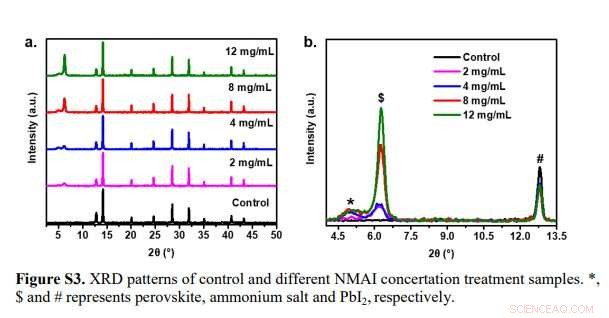
They found that different from PEAI, NMAI post-treatment remains almost NMAI salt itself on the surface of perovskite film rather than transformed into low-dimensional perovskites, even under high thermal annealing temperature (100 °C), which was supported by density functional theory (DFT) calculation and X-ray diffraction (XRD) measurement.
Although the researchers had adopted NMAI to construct quasi-2-D/3-D perovskite through one-step preparation method for highly efficient perovskite light-emitting diode (LED), this dielectric ammonium salt could not only efficiently decrease the defect-assisted recombination owing to chemical passivation, but also retard the charge accumulation by inducing energy level bending and prevent minority carrier recombination due to charge-blocking.
The NMAI-treated devices showed much more intensified electroluminescence, which is direct evidence that NMAI treatment substantially suppresses the non-radiative recombination at the surface/interface of perovskite in the complete devices.
Additionally, the researchers achieved a PCE of 21.04% for the triple-action PSC, a maximum VOC up to 1.20 V, and enhanced stability maintaining 98.9% of their initial efficiency after 3240 h.
This study provides new insights into the passivation mechanisms of organic ammonium salts and suggests guidelines for future developing improved passivation layers.